
When SaaS needs Kubernetes: workload signals and a practical pilot
Decide when SaaS needs Kubernetes using measured orchestration problems, replica readiness, operating ownership, a bounded pilot and verified recovery.
7 min read
In this article
A SaaS product can have a containerized frontend, API, database and queue without needing a Kubernetes cluster. If the real problem is a slow SQL query, an untested backup or a worker that duplicates jobs, an orchestrator adds another operating layer without fixing the cause. The useful question is which measured problem the platform would solve.
This guide explains when SaaS needs Kubernetes through workload signals, operational readiness and a bounded pilot. We will distinguish application orchestration from database recovery, compare simpler options and record a migration decision. The focus is a small team running Laravel or Node services, not a tutorial for installing a production cluster.
Kubernetes can automate desired-state workload management, deployment and scheduling. Those capabilities become valuable when the application and team are ready to use them. They do not remove responsibility for secure configuration, compatible schemas, customer data or incident response.
Step 1: Identify the problem before selecting the platform
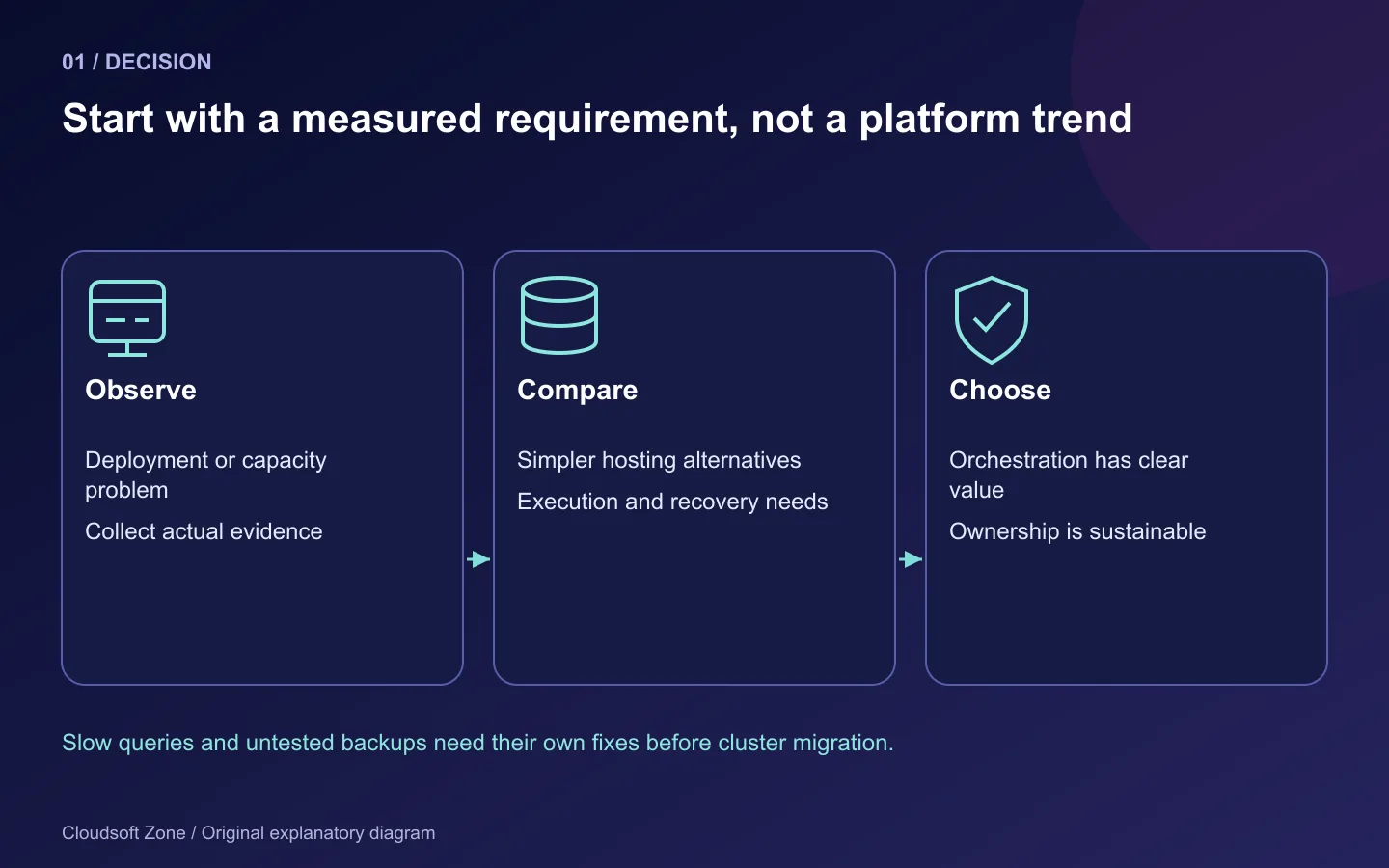
Write a specific trigger, such as “independently deploying several stateless services has become unreliable” or “we need replicas distributed across multiple failure domains with a tested rollout process.” Then collect evidence showing why the present design cannot meet the requirement.
Poor triggers include “we use Docker,” “traffic might grow” and “large companies use it.” A single well-operated VPS, managed application platform or managed container service may satisfy the current workload with fewer components to maintain. Start with our hosting decision workbook to compare actual execution requirements.
| Observed problem | First investigation |
|---|---|
| Slow responses | Query plans, dependency latency and resource contention |
| Queue backlog | Job duration, worker capacity and safe retry policy |
| Deployments fail | Artifact consistency, migration compatibility and readiness |
| Host failure causes outage | Failure-domain and state-recovery design |
| Many service releases are difficult to coordinate | Orchestration and platform ownership |
Fix application defects before interpreting them as orchestration demand. Otherwise the same defect becomes harder to diagnose across more pods and network boundaries.
Step 2: Understand what Kubernetes provides—and what it does not
A Deployment manages a desired set of application pods and supports controlled updates. Services provide stable routing to selected workloads. Jobs and CronJobs support bounded tasks and scheduled execution. The platform can place workloads according to resource and scheduling constraints.
Those mechanisms do not guarantee that customer work is idempotent or that the database can be restored. Two API replicas on the same failed node are not high availability. A persistent volume is a storage primitive, not proof of a consistent off-cluster backup.
Rolling an application image back also does not reverse accepted business writes or database changes. You still need compatible migrations and release verification. Autoscaling can increase database pressure if every new pod opens an unrestricted connection pool.
Treat the cluster as an operating platform with its own access, networking, upgrades, capacity and observability. A managed control plane can move some responsibilities to a provider, but it does not manage every workload policy or application failure for you.
Step 3: Check whether the application can run as replaceable replicas
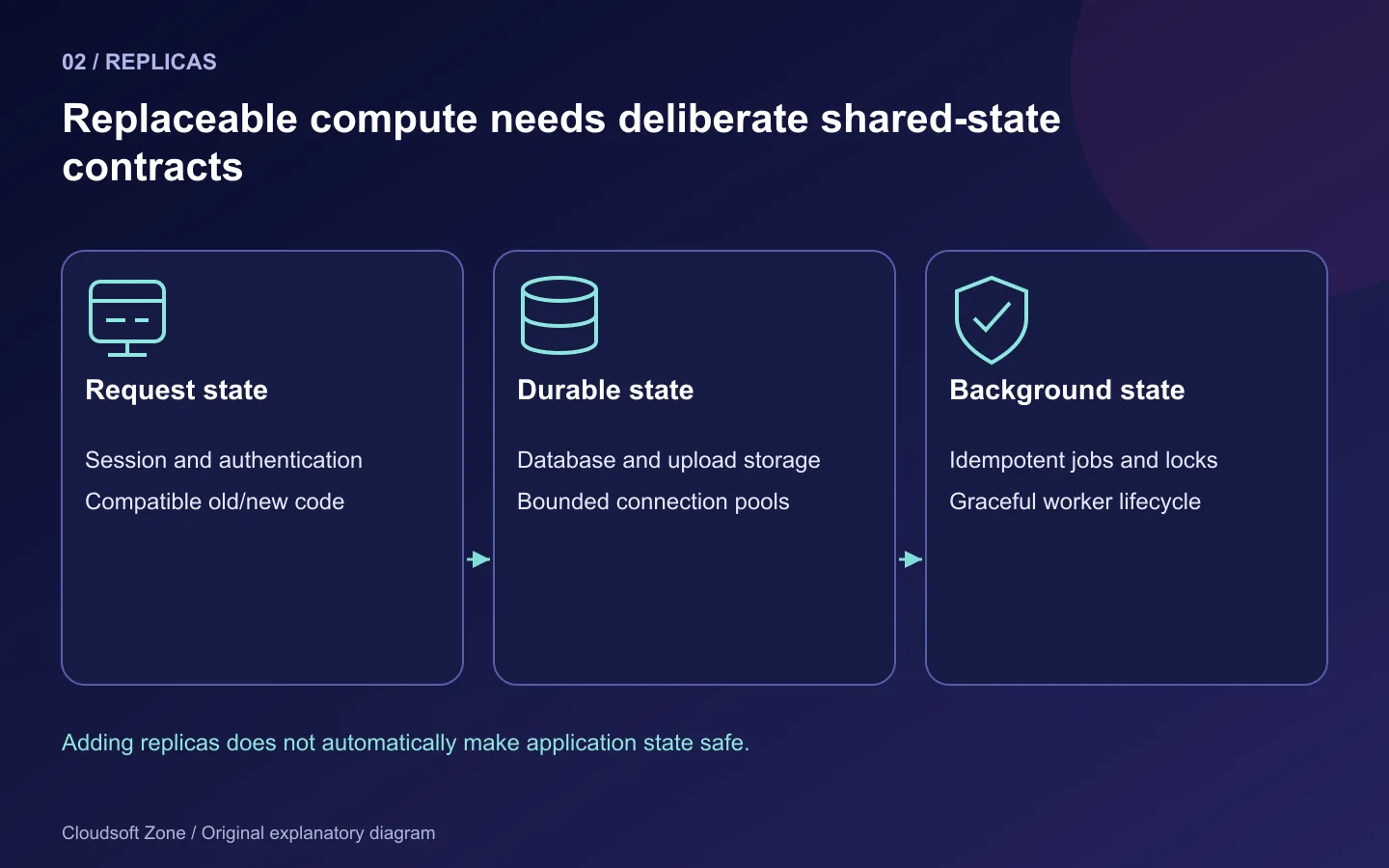
Before adding replicas, remove hidden single-process assumptions. Sessions should use an appropriate shared or client-carried design. Uploads must live in deliberate durable storage. Cache invalidation, locks and scheduled work need a coherent policy across instances.
For Next.js, multi-instance cache coordination and release-version skew need framework-specific review. For Laravel, long-lived workers, job serialization and scheduler locks need compatibility across releases. For NestJS, graceful shutdown and bounded connection pools matter during rescheduling.
Replica readiness review
- No durable customer file exists only inside one pod
- Session and authentication behaviour works across instances
- A job retry cannot silently repeat a business effect
- Old and new code can share the transitional schema
- Graceful shutdown has a bounded completion policy
- Database pools fit the planned replica count
These are application contracts, not boxes automatically checked by a container image. Prove them on staging before a cluster migration. If one fails, fix the owner in the application rather than adding a second workaround in deployment YAML.
Step 4: Budget operating work as well as infrastructure
Name who owns cluster version updates, node lifecycle, ingress or gateway routing, certificate renewal, network policies, secret handling and workload observability. Include out-of-hours recovery and provider-specific storage behaviour.
A realistic estimate includes application compute, temporary rollout capacity, control-plane charges where applicable, load balancers, retained storage, backups, logs and engineering time. Use current quotes for the selected provider and region; there is no universal Kubernetes monthly price.
Choose whether the team can sustain that ownership. If the goal is simply managed web deployment and a worker component, a managed application platform may address it directly. If you need orchestration but lack control-plane expertise, evaluate a managed cluster while still assigning workload and data responsibilities.
Avoid building an internal platform before you have a product requirement for it. The pilot should answer the named trigger, not demonstrate every feature in the ecosystem.
Step 5: Run one bounded stateless-service pilot
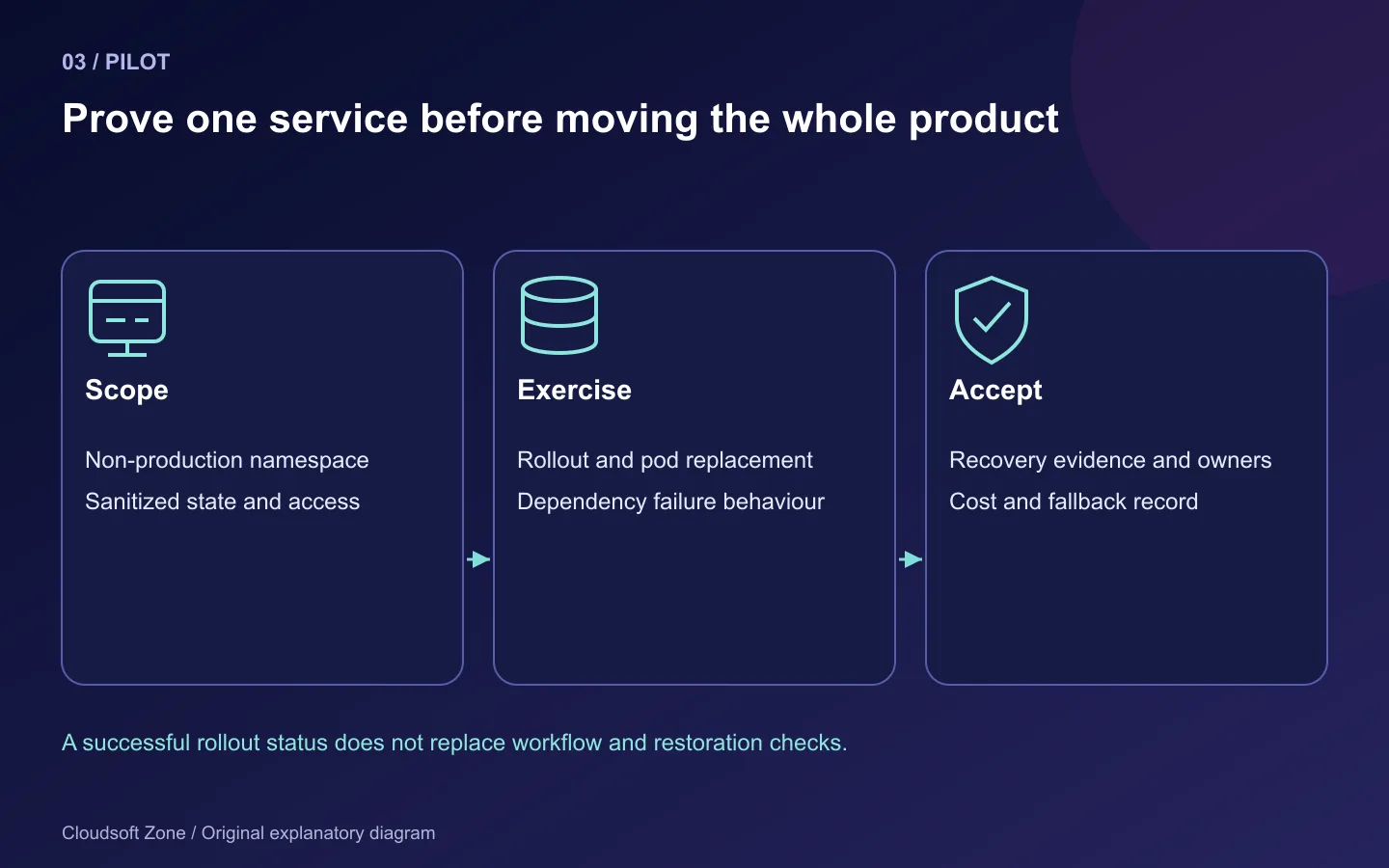
Use a non-production namespace and a reviewed cluster context. Start with one replaceable API service and sanitized state. Keep the production database outside the pilot's credentials and network access.
The following excerpt illustrates a rollout policy and an application container. It belongs inside a complete validated Deployment manifest; it is not a ready-to-apply production manifest:
replicas: 2
strategy:
  type: RollingUpdate
  rollingUpdate:
    maxUnavailable: 0
    maxSurge: 1
# Example entry under spec.template.spec.containers:
# - name: api
#   image: registry.example.com/saas-api:reviewed-release
#   ports:
#     - containerPort: 3001
#   readinessProbe:
#     httpGet: {path: /health/ready, port: 3001}
#     periodSeconds: 10
#   livenessProbe:
#     httpGet: {path: /health/live, port: 3001}
#     periodSeconds: 20
Implement the health routes before referencing them. Readiness controls whether the pod should receive service traffic; liveness detects a condition where restarting the application is useful. Making liveness depend on every external service can turn a database outage into a restart storm. Use a startup probe when slow initialization needs its own window.
Set resource requests from measured steady-state needs and limits from the application's failure policy. Leave room for the surge pod. If the cluster cannot schedule additional capacity, a rollout can stall even though the old pods remain healthy.
Observe the scoped rollout without mutating unrelated workloads:
kubectl config current-context
kubectl --namespace saas-stage get deployments,pods,services
kubectl --namespace saas-stage rollout status deployment/saas-api --timeout=120s
Use the actual approved context and namespace. Do not treat a successful rollout status as the only acceptance check; perform the public workflow and background-effect verification too.
Step 6: Prove the security and data boundaries
Use least-privilege service accounts and restrict human and automation access. Do not give the application cluster-administrator permissions or mount broad credentials into every pod. NetworkPolicy behaviour depends on the network plugin enforcing it; declaring a policy is not enough to prove reachability is restricted.
Kubernetes Secrets are not made secure merely by base64 encoding their values. Review encryption at rest, RBAC, audit access and the chosen external-secret integration. Keep plaintext credentials out of manifests, source control and support logs.
For data, decide whether a managed database outside the cluster is simpler than operating a stateful database workload. Either choice needs verified backups, private access and restoration ownership. StatefulSets and storage claims do not automatically supply database-consistent recovery or regional failover.
Step 7: Exercise disruption and compatibility before migration
| Exercise | Evidence |
|---|---|
| Pod replacement | Requests recover and durable state remains intact |
| Controlled rollout | Old/new versions coexist without schema errors |
| Graceful shutdown | Bounded requests/jobs finish or recover safely |
| Dependency outage | Useful errors and bounded reconnect behaviour |
| Isolated restore | Database and uploads verified off the original system |
| Access restriction | Unapproved identities cannot mutate workloads or read secrets |
Pod disruption budgets can limit supported voluntary disruptions, but they are not a guarantee against node failure or every rollout path. Test the actual provider and workload behaviour rather than relying on one YAML policy.
Record the migration acceptance decision with the original trigger, pilot evidence, operating owners, cost assumptions and fallback plan. If the evidence shows simpler managed compute meets the requirement, retaining that design is a valid outcome.
A practical decision rule
Adopt Kubernetes when the measured orchestration requirement and a sustainable operating model justify it. Defer it when the immediate need is better query performance, safer releases, tested recovery or straightforward managed hosting. There is no honest universal customer-count threshold that makes a cluster necessary.
Use our Compose production checklist and Laravel release guide to strengthen a smaller deployment first. For a scoped architecture and migration review, contact Cloudsoft Zone.
Featured image: Cloudsoft Zone explanatory layout with sourced product artwork: kubernetes — Unknown author (Public domain); docker — dotCloud, Inc. (Apache License 2.0). Product marks resized and arranged for identification; no endorsement implied. Layout: CC BY-SA 4.0.
Frequently asked questions
How many users make Kubernetes necessary?
There is no universal threshold. Use measured workload and orchestration requirements, plus a sustainable operating model.
Do two replicas guarantee high availability?
No. Failure-domain placement, dependencies, state and routing matter; two replicas on one failed node do not provide host resilience.
Does a Kubernetes Secret encrypt my password by being base64 encoded?
No. Base64 is encoding. Review encryption at rest, RBAC, access auditing and your secret-management design.
Your next customer could start right here.
Introduce your tool, product or business to readers exploring technology.
Explore placements and request a private quote
Sources
- Kubernetes overview — Kubernetes
- Kubernetes Deployments — Kubernetes
- Kubernetes Secrets — Kubernetes
- Pod resource management — Kubernetes
- Liveness, readiness and startup probes — Kubernetes
- Pod disruptions — Kubernetes
Comments
No comments yet. Be the first to join the conversation.
Leave a comment
Every comment is read by a moderator before it appears. Your email address is never published; it is used only to contact you about this comment.
More from Cloudsoft Zone
TutorialDevOps
Laravel production deployment: from a Git commit to the first live release
Plan a Laravel production deployment from a reviewed Git commit through dependencies, shared storage, configuration, nginx routing and first-release acceptance.
By Cloudsoft Zone
TutorialDevOps
nginx Certbot renewal: configure HTTPS and diagnose certificate failures
Keep nginx Certbot renewal working with domain validation checks, safe certificate installation, deployment hooks and a clear expiry troubleshooting sequence.
By Cloudsoft Zone
Resource guideDevOps
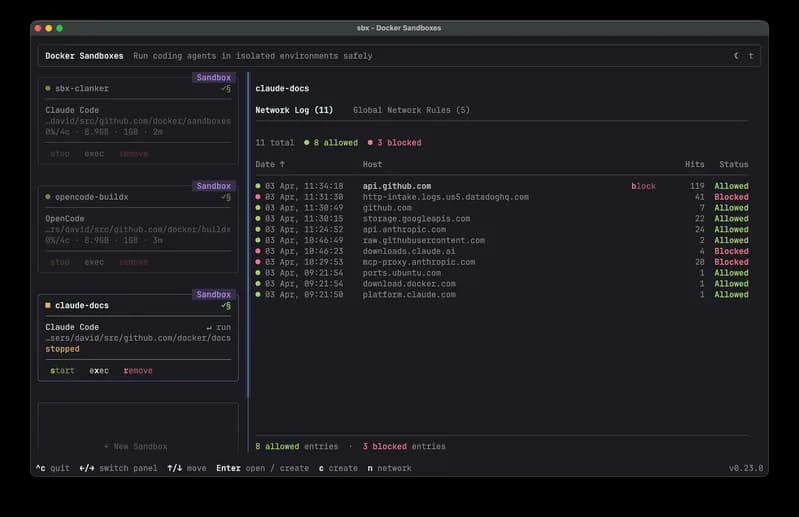
Docker AI tools explained: Gordon, Agent, Skills, MCP and Sandboxes
Understand Docker AI tools by their roles: Gordon assistance, Agent orchestration, Skills guidance, MCP connections and isolated Sandboxes.
By Cloudsoft Zone