
VPS vs managed hosting vs serverless: a SaaS decision workbook
Compare VPS vs managed hosting vs serverless using workload requirements, operating ownership, current cost inputs, pilot evidence and recovery targets.
7 min read
In this article
A low monthly server price does not tell you what it costs to run a SaaS product. Someone must patch the operating system, restore the database, watch failed jobs and respond when an update breaks login. A managed platform can reduce that work, while a serverless design can move it into quotas, event handling and connection management.
This VPS vs managed hosting vs serverless guide is a decision workbook for a Laravel or Node-based SaaS. We will describe the workload, reject incompatible options, compare total operating cost and rehearse recovery before choosing. Our existing hosting overview explains the models; this article turns the choice into evidence you can record.
Provider limits, supported runtimes and prices change. Use the current documentation for the specific service and region when completing the worksheet. The examples below are hypothetical workload decisions, not performance benchmarks or claims about a provider's current bill.
Step 1: Describe the workload before comparing plans
Write down the application's request path and background work. A mostly static marketing site differs from a multi-tenant dashboard with MySQL transactions, Redis queues, uploads, scheduled billing and long-running exports. “It is a small SaaS” is too vague to choose an execution model.
Web: server-rendered dashboard and authenticated API
State: relational database, sessions and retained uploads
Background work: queued reports and notification delivery
Scheduled work: bounded billing and maintenance tasks
External dependencies: email, object storage and payment API
Recovery needs: acceptable data loss and restoration time
Team: named operator and realistic incident availability
Record normal and peak concurrency, request duration, job duration, upload sizes and database connection demand from the actual application or a staging workload. If those measurements do not exist yet, mark them unknown and choose a conservative pilot rather than inventing traffic numbers.
Separate durable state from compute. Images or functions can be replaced; customer records and uploaded files need retention and restoration. An application that assumes every instance shares a local directory must be adapted before moving to ephemeral compute.
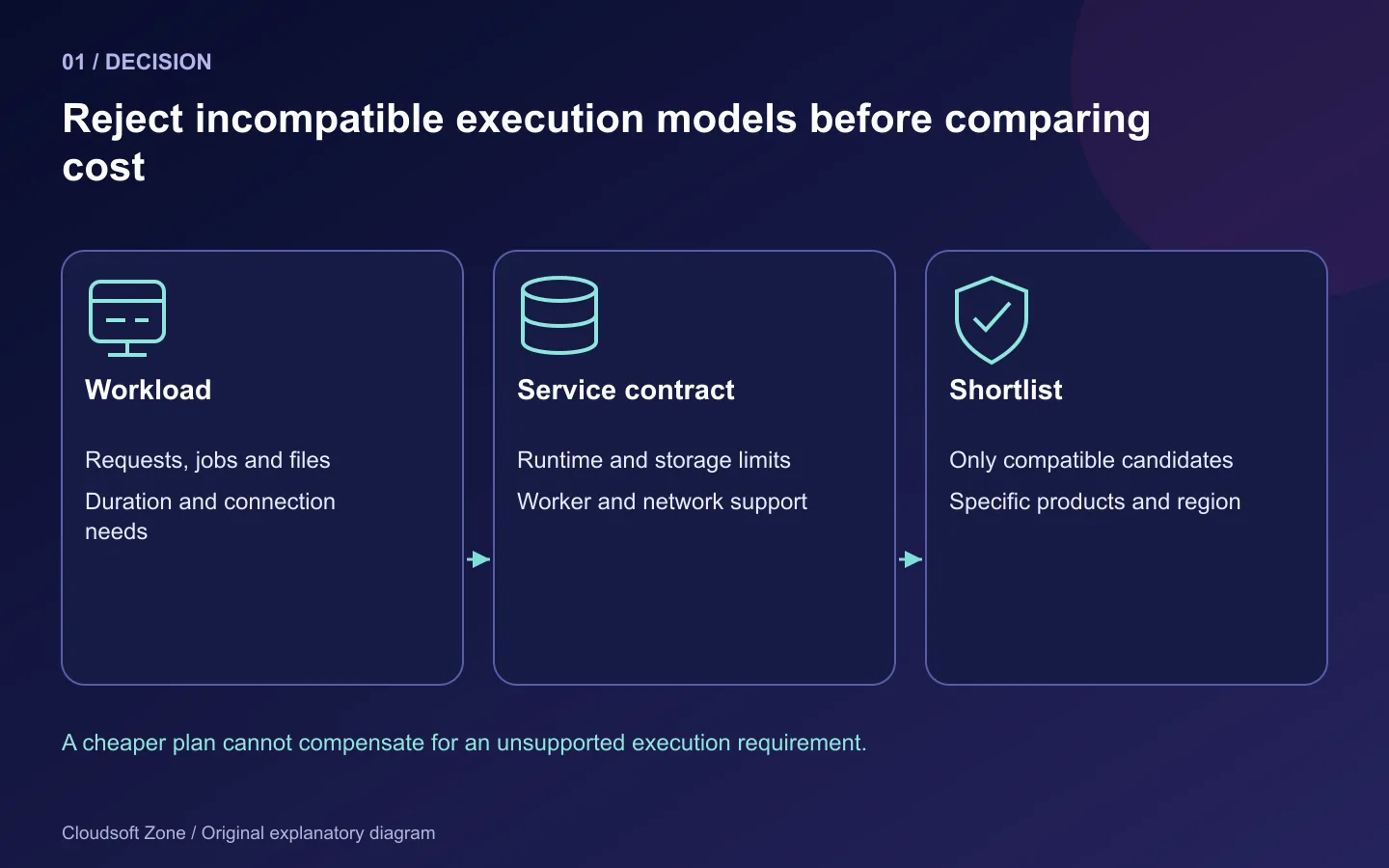
Step 2: Reject options that cannot satisfy the execution contract
A VPS gives you control over operating-system processes, ports, local storage and long-running workers. That flexibility also leaves patching, access, backups and service supervision with your team unless a separate managed service is purchased.
A managed application platform commonly accepts source or images and supplies deployment and runtime management. The exact product may support web services, worker components, scheduled jobs and managed databases differently. Read the service's filesystem, networking, build and runtime limits before committing.
Serverless functions fit bounded request or event handlers. A function platform has specific duration, concurrency, payload and temporary-storage limits. AWS Lambda is one example with documented quotas; those limits are not universal definitions of serverless. Work that exceeds the chosen function contract needs a different execution service or a redesigned bounded workflow.
| Requirement | VPS question | Managed-platform question | Function question |
|---|---|---|---|
| Long queue job | Can you supervise and recover it? | Is a worker component supported? | Does it fit the actual invocation limit? |
| Retained uploads | Are backups and permissions managed? | Is local disk persistent or ephemeral? | Which object store owns the durable file? |
| Relational database | Can you maintain or buy a database service? | What connection and network options exist? | How is burst connection demand bounded? |
| Scheduled work | Who owns cron and failure alerts? | What scheduling primitive is provided? | How are event delivery and retries controlled? |
A hard incompatibility should eliminate an option before cost scoring. Do not compensate for an unsupported long-running process by giving the product a high score for a cheap introductory plan.
Step 3: Assign operating responsibility explicitly
“Managed” is a scope of responsibility, not the absence of work. The provider may maintain physical infrastructure and a runtime layer while you still own application authorization, dependency updates, secret access, customer data and configuration.
Make a responsibility matrix for the actual contract:
| Task | Named owner | Evidence |
|---|---|---|
| OS/runtime patches | Team or provider | Documented scope and update procedure |
| Database restoration | Team or database service | Isolated restore record |
| Application release | Application team | Reviewed artifact and rollback procedure |
| Secret rotation | Application/security owner | Tested rotation path |
| Queue recovery | Application operator | Failed-job and idempotency runbook |
| Incident response | Named on-call owner | Contact route and recovery targets |
A solo founder who cannot operate a database reliably may benefit from a managed database even while keeping application compute on a VPS. A team with strong Linux operations may accept VPS ownership deliberately. Avoid assuming technical control is free just because nobody invoices the founder for their time.
Step 4: Compare total cost with a worksheet
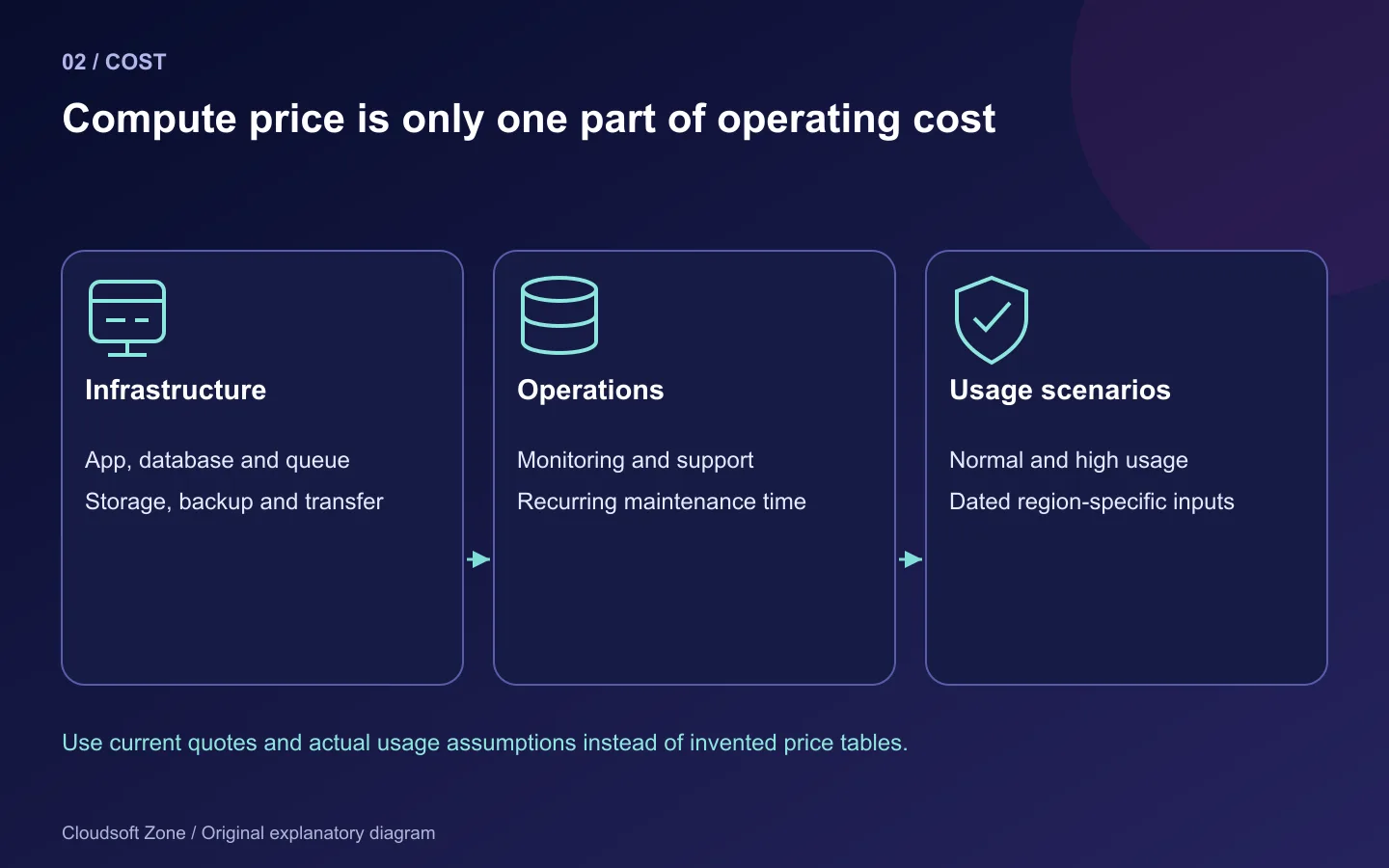
Use equivalent workload and recovery requirements for every candidate. Include production and staging, retained storage, backups, network transfer, database, Redis, logs and support. Free tiers and introductory credits should not define the long-term architecture.
Monthly operating estimate =
  application compute
  + database and queue services
  + storage, backups and transfer
  + logging and monitoring
  + support and recurring operations time

One-time change estimate =
  migration engineering
  + data transfer and validation
  + recovery rehearsal
  + application adaptations
Enter current region-specific quotes and measured usage; the formula intentionally supplies no invented dollar amounts. For variable-cost services, calculate a normal month and a plausible high-usage month. Include request amplification from retries, large logs and abusive traffic.
Account for concurrency limits and budget controls, but distinguish an alert from a hard spending cap. A billing alert may notify you after usage has accrued. Verify what the service actually enforces and decide how the application behaves when capacity is throttled.
Step 5: Test three realistic architecture candidates
Consider a hypothetical small business SaaS with a server-rendered web app, API, relational database and report queue. Three candidates are worth testing:
Candidate A: one application VPS with private state services. It offers a simple topology and predictable process ownership. The team must maintain the host and rehearse restoration. If database and app share a host, host failure affects both; off-host backups are essential.
Candidate B: managed web and worker components plus a managed database. It moves some infrastructure lifecycle work to the platform. Confirm worker support, connection limits, private networking and durable upload storage. Do not assume a web-service component can run an unrelated permanent queue process under its supported contract.
Candidate C: bounded serverless request/event handlers with external durable state. It can suit uneven event-driven work. Review invocation limits, database connection pressure, retries, idempotency and cold-start behaviour for the selected service. A conventional long-running worker may remain on a separate managed compute service.
These are mixed architectures, not ideological choices. A mostly static frontend can use managed static hosting while the API and workers use another model. Choose boundaries that reduce operational risk without splitting the product into unnecessary services.
Step 6: Run a representative pilot, including failure paths
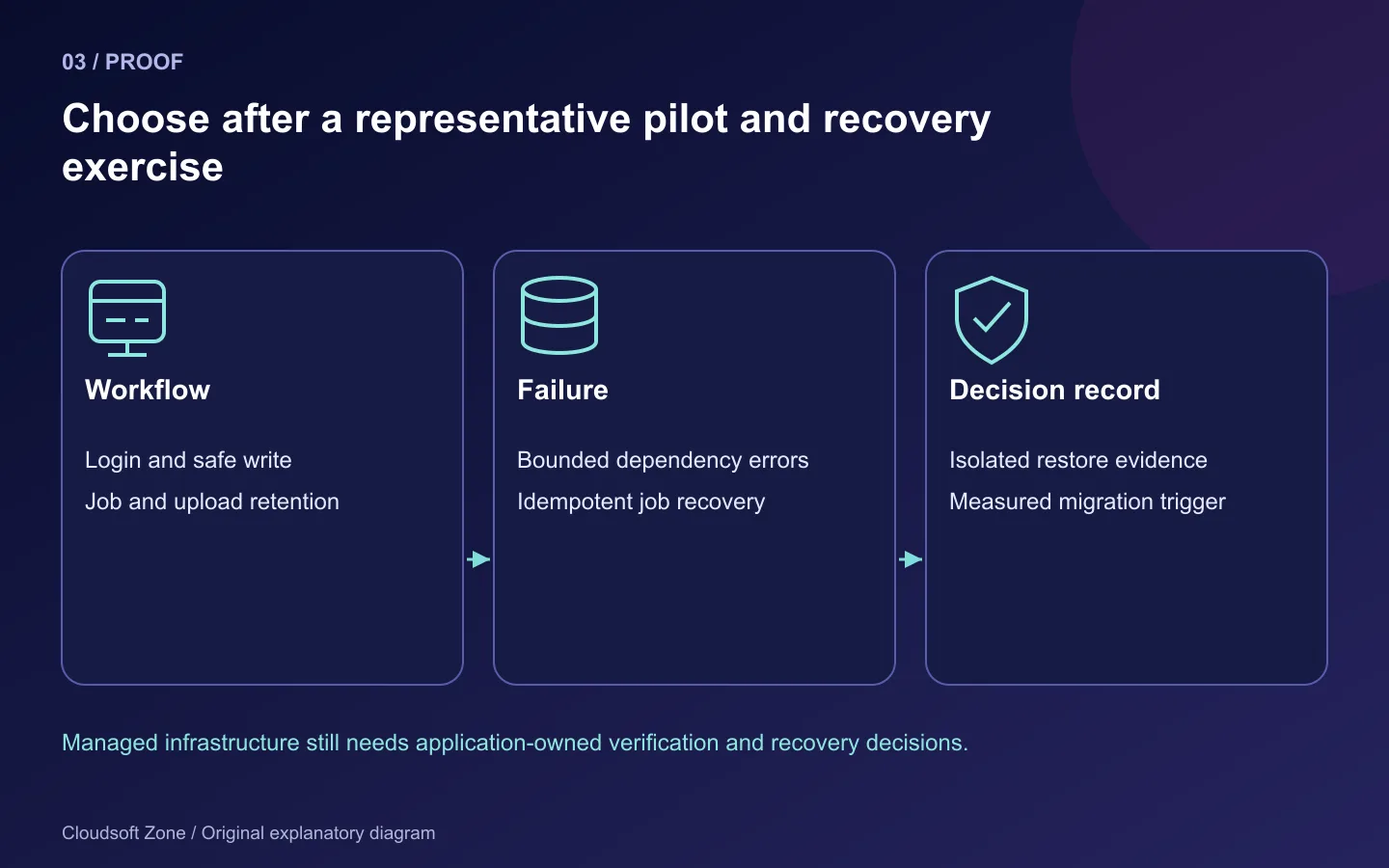
Deploy the same reviewed application path to shortlisted options and collect comparable evidence. Check login, one synthetic write, upload retention, queue completion and a due scheduled action. Record public request latency and database connections under representative concurrency rather than measuring only a cached homepage.
Then exercise a safe failure: restart a staging process, temporarily make a dependency unavailable or simulate a failed job. Confirm bounded retries, useful errors and recovery. Do not perform those exercises on real customers to obtain a comparison chart.
For state, restore a sanitized backup into an isolated environment and verify relationships and files. Test a compatible application rollback. A platform's ability to redeploy an old image cannot guarantee that the old schema or accepted business writes can be reversed.
Step 7: Record the decision and the migration trigger
Chosen model and services: <specific products and region>
Rejected options: <documented execution incompatibilities>
Operating owners: <patches, data, queues and incident response>
Normal/high-usage estimates: <dated quote and usage assumptions>
Pilot evidence: <workflows, failure recovery and restore record>
Migration trigger: <measured limit or ownership problem>
Review date: <when limits, costs and workload are checked again>
A good migration trigger is observable: a worker duration exceeds the supported contract, the team cannot meet restoration targets, database contention remains after query fixes, or operating cost becomes unacceptable under measured usage. “Kubernetes is popular” is not a workload trigger.
Common mistakes include choosing only by VM price, forgetting worker services, treating ephemeral disk as upload storage and moving a database without a tested rollback. For a self-managed path, use the VPS deployment guide. For containers, use the Compose production checklist.
The right hosting model is the simplest one that satisfies the application's execution and recovery requirements under ownership the team can sustain. For a scoped architecture review, discuss your SaaS with Cloudsoft Zone.
Featured image: Cloudsoft Zone explanatory layout with sourced product artwork: ubuntu — Canonical Ltd (Public domain). Product marks resized and arranged for identification; no endorsement implied. Layout: CC BY-SA 4.0.
Frequently asked questions
Is the cheapest VPS always the cheapest SaaS architecture?
No. Include state services, backups, transfer, monitoring, support and the team's recurring operating work.
Does managed hosting remove application security responsibility?
No. Review the exact contract; application authorization, data handling, configuration and secret access remain deliberate responsibilities.
Should every request and queue move to serverless together?
No. Choose an execution service appropriate to each bounded workload and durable-state requirement; mixed architectures can be simpler.
Your next customer could start right here.
Introduce your tool, product or business to readers exploring technology.
Explore placements and request a private quote
Sources
- AWS shared responsibility model — AWS
- AWS Lambda quotas — AWS
- DigitalOcean App Platform limits — DigitalOcean
- Compose production guidance — Docker
Comments
No comments yet. Be the first to join the conversation.
Leave a comment
Every comment is read by a moderator before it appears. Your email address is never published; it is used only to contact you about this comment.
More from Cloudsoft Zone
TutorialDevOps
Laravel production deployment: from a Git commit to the first live release
Plan a Laravel production deployment from a reviewed Git commit through dependencies, shared storage, configuration, nginx routing and first-release acceptance.
By Cloudsoft Zone
TutorialDevOps
nginx Certbot renewal: configure HTTPS and diagnose certificate failures
Keep nginx Certbot renewal working with domain validation checks, safe certificate installation, deployment hooks and a clear expiry troubleshooting sequence.
By Cloudsoft Zone
Architecture guideDevOps
When SaaS needs Kubernetes: workload signals and a practical pilot
Decide when SaaS needs Kubernetes using measured orchestration problems, replica readiness, operating ownership, a bounded pilot and verified recovery.
By Cloudsoft Zone