

In this article
Two critical PHP RCE vulnerabilities were fixed on 21 October 2026 in PHP 8.5.12, 8.4.27, 8.3.36 and 8.2.35. Both can allow unauthenticated remote code execution, and both are rated CVSS v4.0 9.2. The PHP project says updating is the only safe choice.
This guide covers the patched versions, how exposure differs between Apache mod_php, PHP-FPM and other server APIs, and a rollout you can follow today. It contains no exploit details.
Sources checked on 26 October 2026. Advisories, prices and availability can change; confirm the linked primary sources before acting.
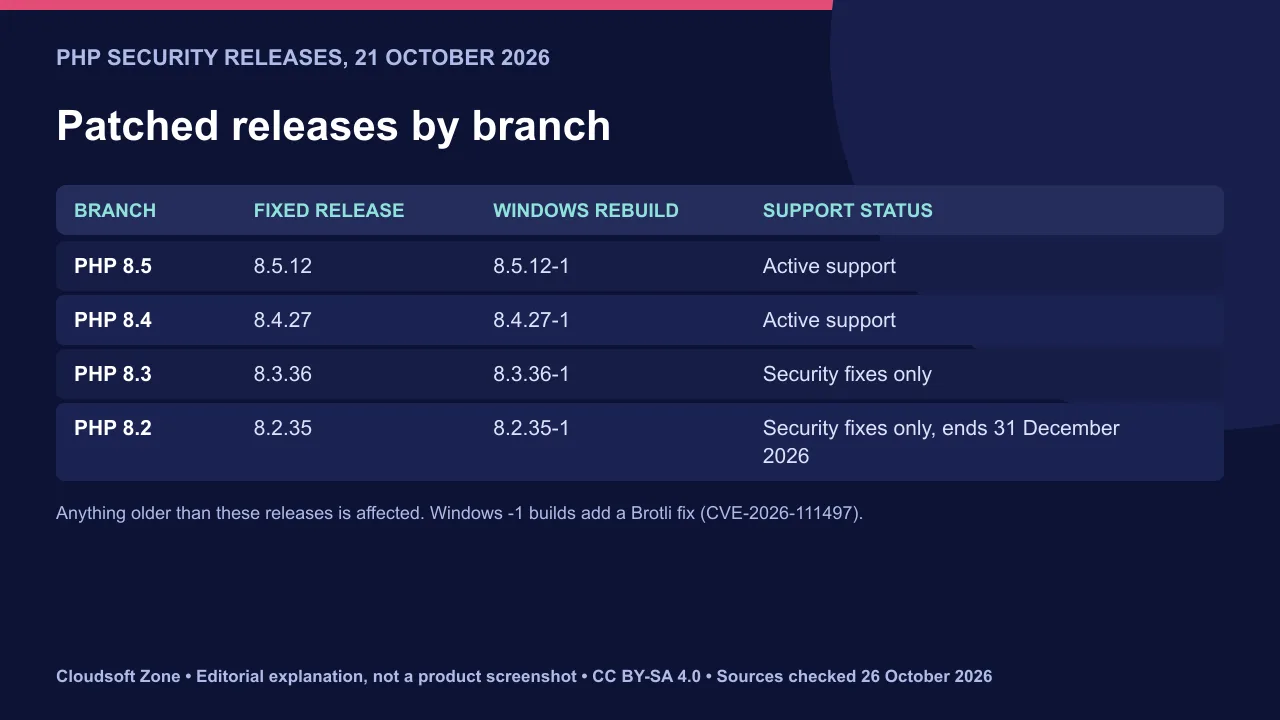
Which versions fix the PHP RCE vulnerabilities?
Every supported branch has a fixed release. Anything older than the version below is affected.
| Branch | Fixed release | Windows rebuild (26 October) |
|---|---|---|
| 8.5 | 8.5.12 | 8.5.12-1 |
| 8.4 | 8.4.27 | 8.4.27-1 |
| 8.3 | 8.3.36 | 8.3.36-1 |
| 8.2 | 8.2.35 | 8.2.35-1 |
The two issues are CVE-2026-109618 (memory exhaustion that corrupts state) and CVE-2026-109619 (stale global state). Their GitHub advisories are GHSA-w8hw-w9fx-j79w and GHSA-6wmf-4rv5-p3rp.
Windows users need one more step. On 26 October the PHP project republished Windows packages with a -1 suffix for a Brotli decompression flaw (CVE-2026-111497). It is reachable through cURL when automatic response decompression is enabled.
Exposure differs by server API
Risk is highest on Apache with mod_php. The PHP project reports a demonstrated unauthenticated path there that runs before any application code.
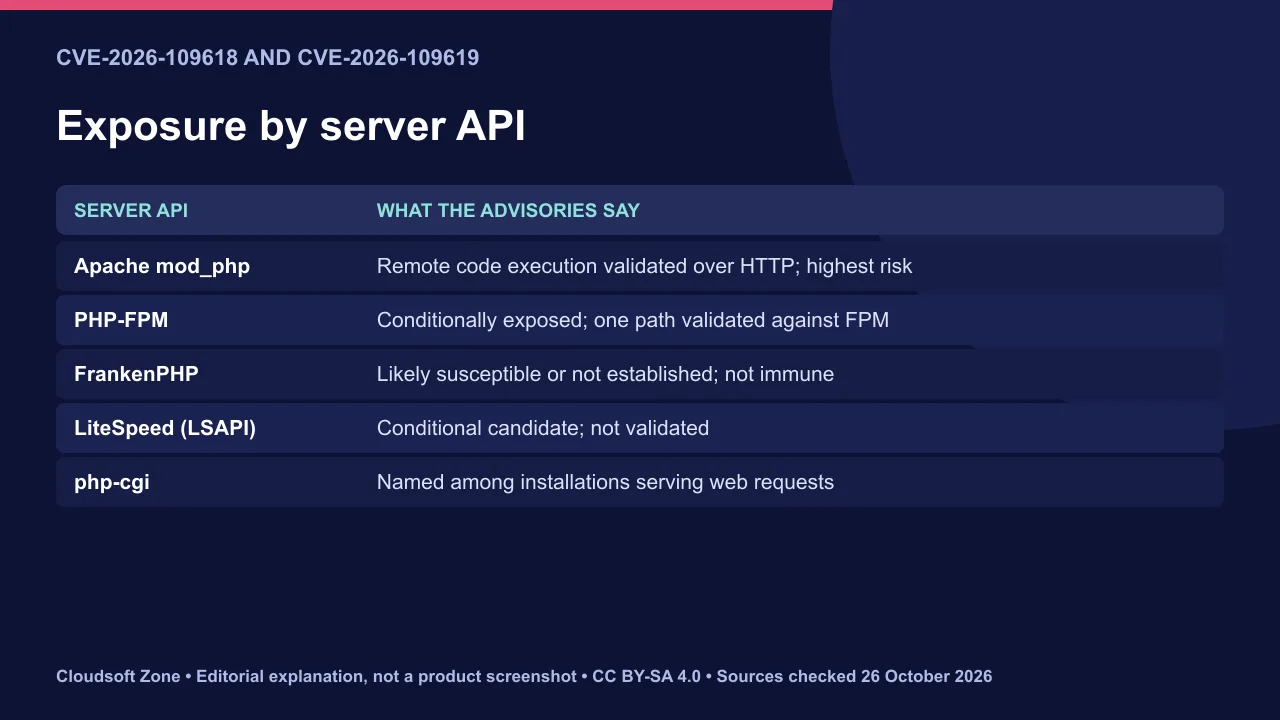
PHP-FPM is conditionally exposed, and one path was validated against it. FrankenPHP and LiteSpeed are described as likely or conditional candidates. The release announcement covers all installations serving web requests, including php-cgi. Not demonstrated is not the same as safe.
Command-line PHP that never handles HTTP requests is not named. Treat every web-facing worker as in scope, including staging servers and forgotten admin hosts.
Interim measures while you schedule the upgrade
Interim settings reduce specific attack paths; they do not make a server safe. Use them only to bridge the hours before patched packages are live.
- Set
session.upload_progress.enabled=0in php.ini, the FPM pool or server configuration. Do not rely onini_set()or.user.ini. Restart every worker. - Limit request size at the reverse proxy, and lower
post_max_sizeand input limits where the application allows. - Block multipart requests at the front end if the application never accepts uploads.
- Remove diagnostics and fatal-error output from paths an attacker can reach.
The advisory also discusses memory_limit=-1 as a partial measure and warns against RLIMIT_AS or RLIMIT_DATA. Removing the memory limit has its own stability cost, so pair it with container or cgroup limits.
A safe upgrade workflow
Inventory first, then patch, restart and verify. Skipping the restart is the most common way a patch silently fails.
- Inventory. Check
php -vandphp-fpm -von each host. CLI and FPM packages can differ. - Back up. Snapshot the server or image and the database before changing packages.
- Patch. Confirm your package source (distribution, PPA, Docker image or Windows build) already ships the fixed release.
- Restart every PHP process. Reload FPM pools and Apache; a long-lived worker keeps the old code in memory.
- Verify. Check the version each pool reports, run smoke tests and watch error logs.
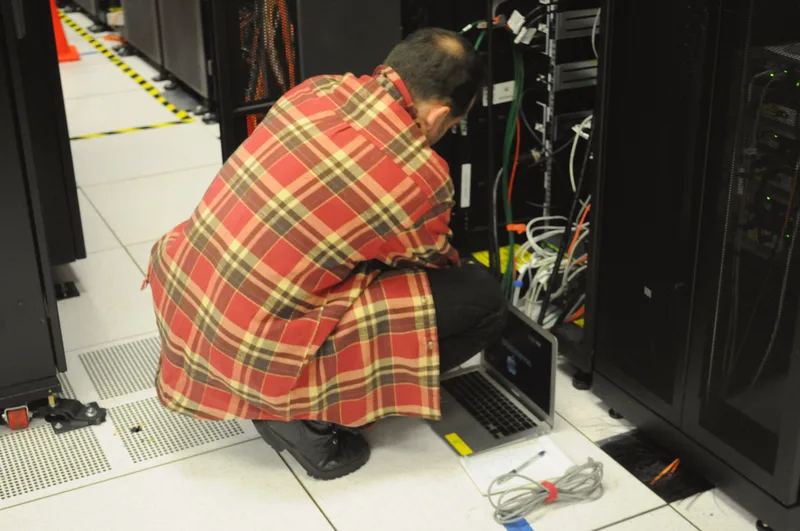
For Docker, rebuild from an updated php base tag and redeploy. Our PHP 8.5.11 security release checklist covers the same restart-and-verify routine.
Laravel and WordPress compatibility checks
These are patch releases within each branch, so code changes are not expected. Test before production anyway.
For Laravel, run the test suite on the new binary, then restart Horizon or queue:work processes so they load it. For WordPress, confirm plugins load, scheduled tasks run and uploads still work. Still on 8.2? Plan the branch move with our PHP 8.2 end-of-life checklist.
Our verdict: patch web-facing PHP today, starting with any mod_php host. If you need a version audit or emergency patching across several servers, our Laravel and PHP development team and maintenance and support service can help.
Sources and further reading
- PHP security announcements, October 2026 — PHP
- RCE via OOM corruption (GHSA-w8hw-w9fx-j79w) — PHP on GitHub
- RCE via stale global state (GHSA-6wmf-4rv5-p3rp) — PHP on GitHub
Image credits
Explanatory diagrams: Cloudsoft Zone, CC BY-SA 4.0. Featured photograph: Atomic Taco from Seattle, WA, USA, CC BY-SA 2.0, via Wikimedia Commons. Technician with laptop working on server rack at NERSC: Derrick Coetzee from Berkeley, CA, USA, CC0, via Wikimedia Commons.
Frequently asked questions
Does a configuration change replace the upgrade?
No. The PHP project says there are no complete mitigations and that updating is the only safe choice.
Is command-line PHP affected?
The announcement names installations that serve web requests. CLI scripts are not named, but upgrade the package anyway because CLI and FPM usually come from the same source.
Do Windows users need anything extra?
Yes. Install the rebuilt Windows packages with the -1 suffix, published on 26 October, which also fix a Brotli flaw (CVE-2026-111497).
Your next customer could start right here.
Introduce your tool, product or business to readers exploring technology.
Explore placements and request a private quote
Sources
- PHP security announcements, October 2026 — PHP, 2026-10-21
- RCE via OOM corruption (GHSA-w8hw-w9fx-j79w) — PHP on GitHub, 2026-10-21
- RCE via stale global state (GHSA-6wmf-4rv5-p3rp) — PHP on GitHub, 2026-10-21
Written with substantial AI assistance. Facts checked against cited sources. Editorial policy.
Comments
No comments yet. Be the first to join the conversation.
Leave a comment
Every comment is read by a moderator before it appears. Your email address is never published; it is used only to contact you about this comment.
More from Cloudsoft Zone
Troubleshooting guideDevOps
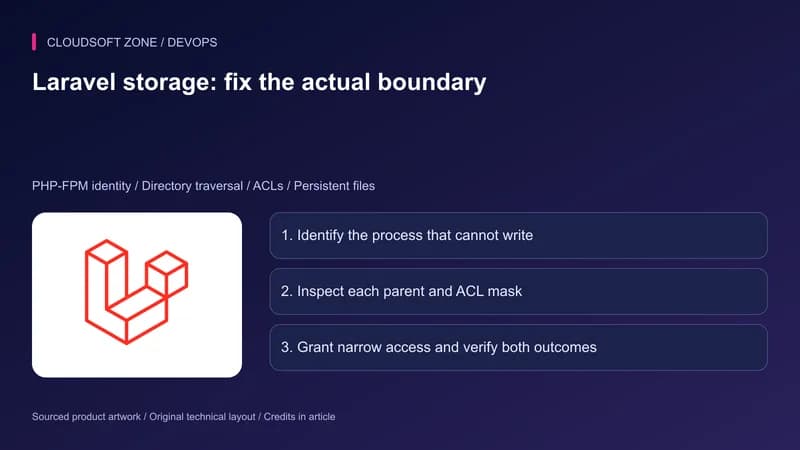
Laravel storage permissions on nginx: diagnose the runtime user before changing access
Fix Laravel storage permissions by identifying the real PHP-FPM and worker accounts, tracing parent directories and granting only required runtime access.
By Cloudsoft Zone
Industry updateDevOps
Cloudflare WAF response rules: why full-transaction detection matters
Cloudflare WAF response rules and full-transaction detection: the WAF now checks each request with its response. What it catches, limits and how to set it up.
By Cloudsoft Zone
TutorialDevOps
Laravel Horizon production controls: dashboard access, capacity and deployment
Review Laravel Horizon production controls for dashboard authorization, queue isolation, bounded capacity, graceful deployments and useful completion alerts.
By Cloudsoft Zone