
MySQL vs PostgreSQL for SaaS hosting: operational differences small teams should evaluate
Compare MySQL vs PostgreSQL through maintenance, connections, recovery, migration compatibility and team experience rather than unsupported universal performance rankings.
5 min read
In this article
A SaaS team chooses a database from a feature comparison, then discovers that nobody has rehearsed restoring it or understands why storage keeps growing. The choice was technically plausible but operationally incomplete.
MySQL vs PostgreSQL for SaaS hosting should include maintenance, connection budgets, recovery and application compatibility. This guide compares MySQL 8.4 and PostgreSQL 18 operating concepts without inventing benchmarks or claiming either database is always better.
Our Laravel and NestJS comparison covers application-stack decisions. Treat the database as a separate workload and operating decision.
Step 1: Define the workload and existing constraints
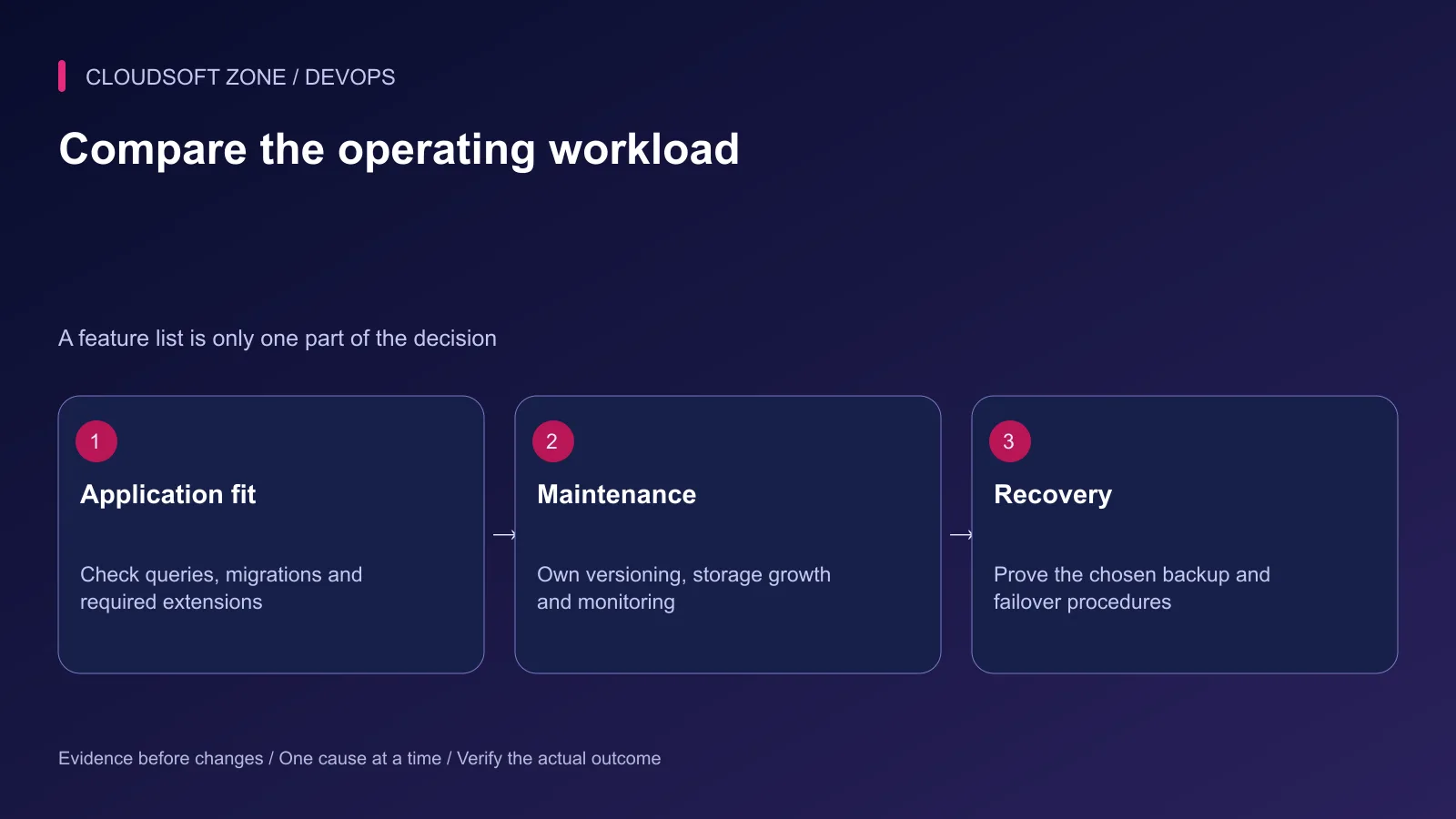
List critical transactions, reporting queries, expected growth, extensions and recovery objectives. Include the current team's experience and the chosen hosting provider's actual supported versions.
If a working SaaS already depends on one database, migration cost belongs in the comparison. A new preferred feature does not automatically justify rewriting retained data, queries and operational tooling.
| Decision area | Question to answer for both candidates |
|---|---|
| Application compatibility | Do schema, raw SQL and migrations behave as required? |
| Operations | Who owns upgrades, access and capacity incidents? |
| Recovery | Can the chosen backup chain meet the recovery objective? |
| Connection pressure | Can all processes coexist within the service limit? |
| Cost | What is the full production and operating bill? |
Use the same acceptance questions for both options. Do not compare an untuned local instance with a managed service and attribute every difference to the database engine.
Step 2: Understand maintenance mechanisms
PostgreSQL uses vacuuming to reclaim reusable space from dead row versions and maintain important metadata. Autovacuum needs monitoring rather than casual global disabling. Standard vacuum and a full table rewrite have different locking and space consequences.
MySQL InnoDB maintains row versions through undo information and its own cleanup mechanisms. Long-lived transactions can affect cleanup and storage behavior here too, but PostgreSQL vacuum commands are not a MySQL operating procedure.
For either database, monitor storage growth, long transactions and maintenance effectiveness. A database that accepts queries today can still be accumulating an operational problem.
Do not recommend aggressive table rewrites as routine disk cleanup. Rehearse their locking, additional space and interruption requirements with the database owner.
Step 3: Budget connections and concurrency
Count web instances, background workers, scheduled tasks and deployment overlap. A process-local pool becomes many pools across the service fleet.
Verify the chosen driver's lifecycle and timeout behavior. An ORM can support both databases while their connectors and pooling configuration remain different.
Reserve access for operations. A proxy or pooler can change session and transaction semantics; confirm compatibility before relying on it to solve every connection-pressure problem.
Assess active work as well as open connections. Raising a connection ceiling cannot fix a slow query and can increase the amount of simultaneous expensive work.
Step 4: Compare complete recovery chains
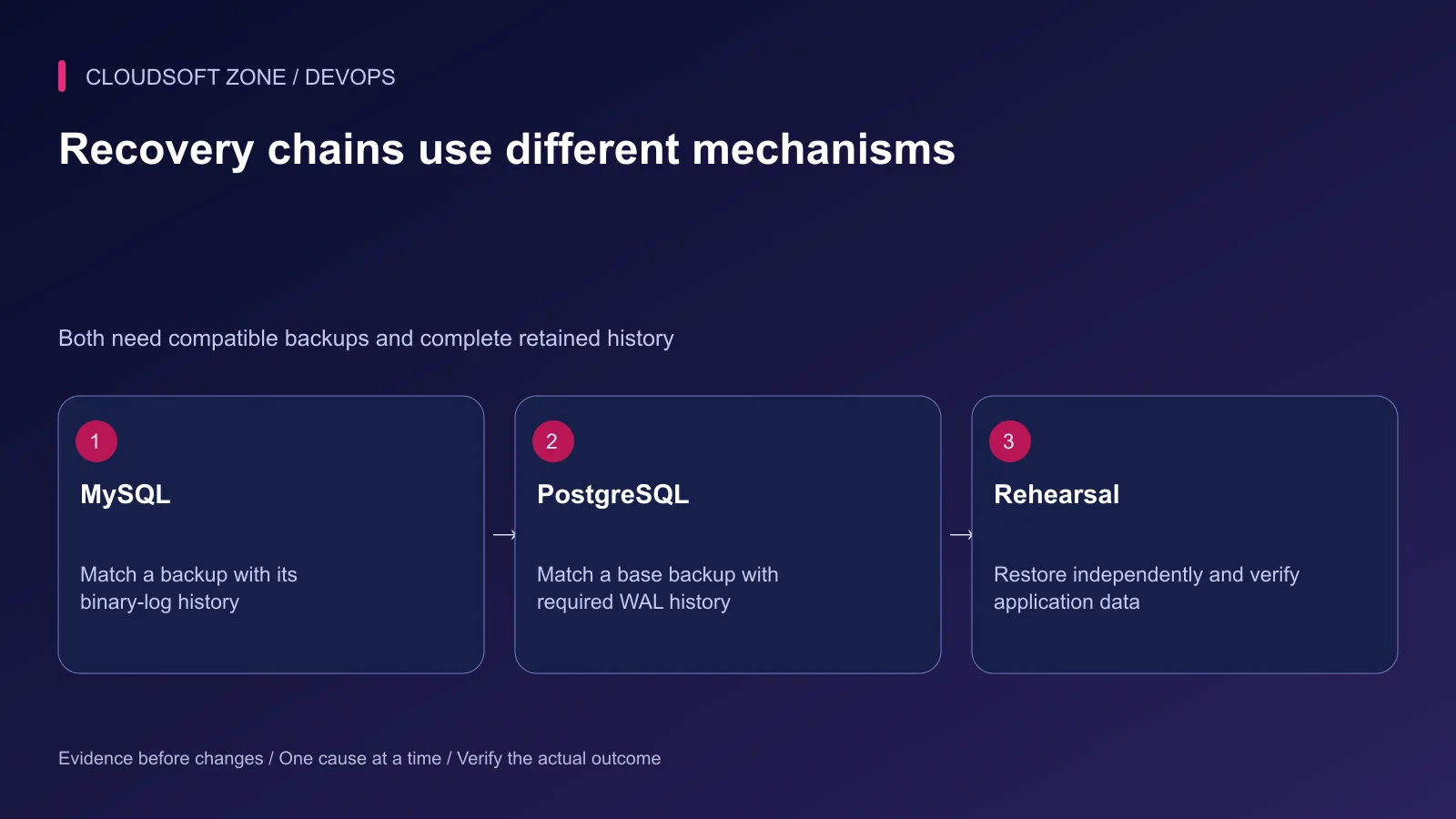
For MySQL point-in-time recovery, a compatible backup and the required binary-log history establish the recovery chain. For PostgreSQL archive recovery, a compatible base backup and required WAL history serve the corresponding purpose.
Neither description means an arbitrary filesystem copy is a consistent backup. Use supported backup mechanisms and preserve the associated version, settings and recovery metadata.
Define the acceptable loss boundary and restoration time before choosing retention. Confirm encryption-key access and that the operator can retrieve recovery material independently of the failed application host.
Our MySQL backup guide and restore-test guide demonstrate that a successful upload is only one stage of recovery evidence.
Step 5: Review application semantics explicitly
Check column types, generated values, constraints, ordering, case sensitivity and timezone assumptions. JSON operators and index designs also vary; framework abstractions do not eliminate every database-specific query.
Inspect raw SQL, migration files, reporting scripts and background tasks. A successful connection and one simple model query do not prove that a complete SaaS behaves identically after a switch.
Use approved fixtures that cover edge cases: non-ASCII text, large values, missing optional data, uniqueness conflicts and concurrent writes. Preserve the intended business behavior rather than changing validation to hide incompatibility.
Step 6: Run a fair MySQL vs PostgreSQL operating evaluation
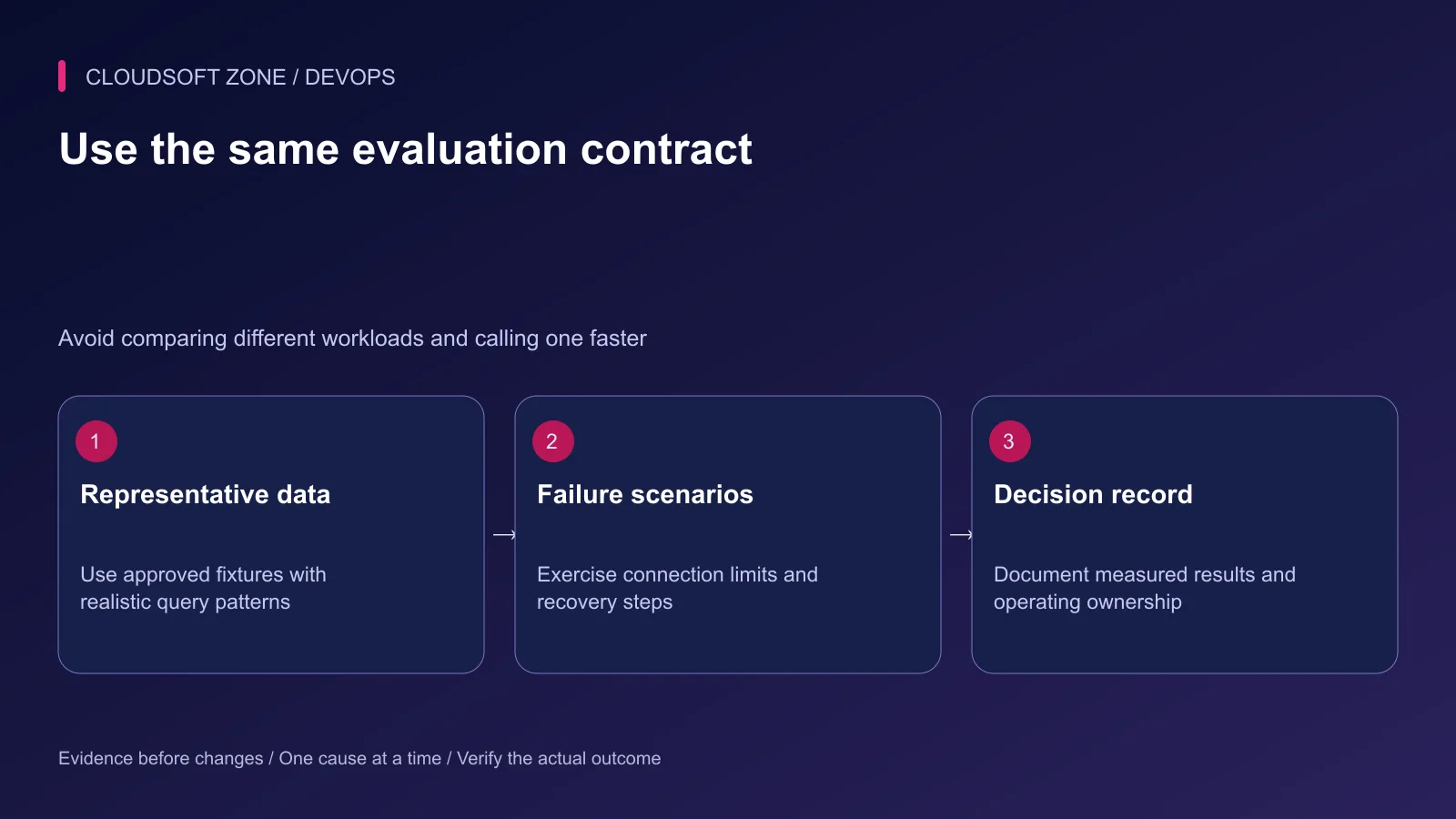
Choose the same representative query and failure scenarios for each candidate. Record version, schema, data size, indexes, host resources and effective configuration alongside measurements.
Do not invent latency numbers or extrapolate an idle development result to production. Include operational exercises that matter to the team, not only throughput tests.
candidate_database_and_version:
representative_workload:
required_application_changes:
connection_peak_and_reserve:
maintenance_owner:
restore_evidence_and_duration:
monthly_cost_assumptions:
accepted_tradeoffs:
This worksheet captures a decision; it is not a benchmark result.
| Exercise | Evidence to retain |
|---|---|
| Representative queries | Plans, data shape and observed timing |
| Connection pressure | Acquisition behavior and recovery |
| Isolated restore | Restored application and critical data checks |
| Version upgrade | Compatibility findings and reversal constraints |
Step 7: Choose an owned operating plan
A team experienced with MySQL may reasonably retain it when the workload fits. Another team may choose PostgreSQL for specific application requirements and a verified operating path. Make the rationale concrete rather than treating popularity as proof.
For managed services, read the actual plan's backup, maintenance and access contract. The provider can take on infrastructure duties while the application team still owns queries, data semantics and recovery acceptance.
For a database and hosting evaluation fitted to your SaaS, discuss the project with Cloudsoft Zone.
Featured image: Cloudsoft Zone technical layout with mysql artwork by Oracle Corporation; vectorized by VulcanSphere (Public domain (text logo); trademark retained). Product mark resized proportionally for identification; no endorsement implied. Layout: CC BY-SA 4.0.
Frequently asked questions
Is MySQL or PostgreSQL always faster for a SaaS?
No universal ranking is reliable. Performance depends on schema, queries, indexes, configuration, workload and hardware; compare representative operations fairly.
Can I switch databases without reviewing Laravel migrations and queries?
No. Framework support does not guarantee identical SQL, collation, types, constraints or migration behavior. Review raw SQL and application assumptions.
Does using a managed database remove all operational duties?
No. The provider takes on selected infrastructure duties, while the application team still owns query behavior, access, compatibility and recovery verification.
Sources
- PostgreSQL18 vacuum and maintenance — PostgreSQL
- PostgreSQL18 archive recovery — PostgreSQL
- PostgreSQL18 connection configuration — PostgreSQL
- MySQL8.4 row-version lifecycle — MySQL
- MySQL8.4 point-in-time recovery — MySQL
- Laravel supported databases and connections — Laravel
Read next
TutorialDevOps5 min read
MySQL production configuration for Laravel applications: a safe operating baseline
Review MySQL production configuration for Laravel using measured memory and connection budgets, explicit durability, protected access and verified restore procedures.
New tools, once a week
One short email listing what joined the directory.
Comments
No comments yet. Be the first to join the conversation.
Leave a comment
Every comment is read by a moderator before it appears. Your email address is never published; it is used only to contact you about this comment.
More from Cloudsoft Zone
Troubleshooting guideDevOps5 min read
Database connection pool exhaustion: causes, symptoms and safe fixes
Diagnose database connection pool exhaustion by separating application acquisition waits, server limits, leaked clients and slow transactions before increasing capacity.
By Nilesh Kushvaha
TutorialDevOps5 min read
Production stack monitoring: nginx, PHP-FPM, MySQL, Redis and queue workers
Build production stack monitoring with private nginx and PHP-FPM status, MySQL connection signals, Redis memory context and queue progress instead of process-only checks.
By Nilesh Kushvaha
TutorialDevOps5 min read
Stop a failed database migration from turning into a broken production deployment
Contain a failed database migration with explicit release gates, schema postconditions and reviewed recovery instead of switching code or retrying blindly.
By Nilesh Kushvaha