
Laravel vs NestJS for SaaS development in 2026: an honest comparison
Laravel 13 or NestJS 12 for a SaaS? Ecosystem for auth, billing, queues and admin, typing, performance, hiring, testing and deployment, with the same endpoint built in both.
Updated 10 min read
In this article
For a small or mid-sized SaaS in 2026, Laravel gets you to a paying product faster because billing, admin panels, auth scaffolding, queues and deployment tooling come from one ecosystem, while NestJS fits better when your team is already TypeScript-first, your frontend is React or Next.js and you want one language and shared types end to end. Neither is meaningfully faster for typical SaaS workloads; the database and your queries decide that. This comparison sets out what each framework gives you today, where each one costs you time, and a decision table you can apply to your own team.
Versions compared (September 2026): Laravel 13 (released 17 March 2026, requires PHP 8.3 or later, security fixes until 17 March 2028) and NestJS 12 (released 27 August 2026, requires Node.js 20.19+ or 22.12+). Tested with: the same small endpoint built in both, run on PHP 8.5 with Laravel 13 and on Node.js 24 with NestJS 12 and Zod 4.
Where each framework stands
Laravel 13 continued the yearly major release cycle with few breaking changes and added first-party AI primitives (the Laravel AI SDK), JSON:API resources and vector search support. Laravel majors get 18 months of bug fixes and two years of security fixes.
NestJS 12 moved every core package to ESM (existing CommonJS apps keep working through Node's require(esm)), added first-class Standard Schema validation so Zod, Valibot or ArkType schemas can validate request bodies directly, rebuilt the CLI with a nest upgrade command, and introduced an optional observability SDK, @nestjs/observe. New projects default to Vitest and oxlint; the decorator-based class-validator workflow is still supported.

The ecosystem a SaaS actually needs
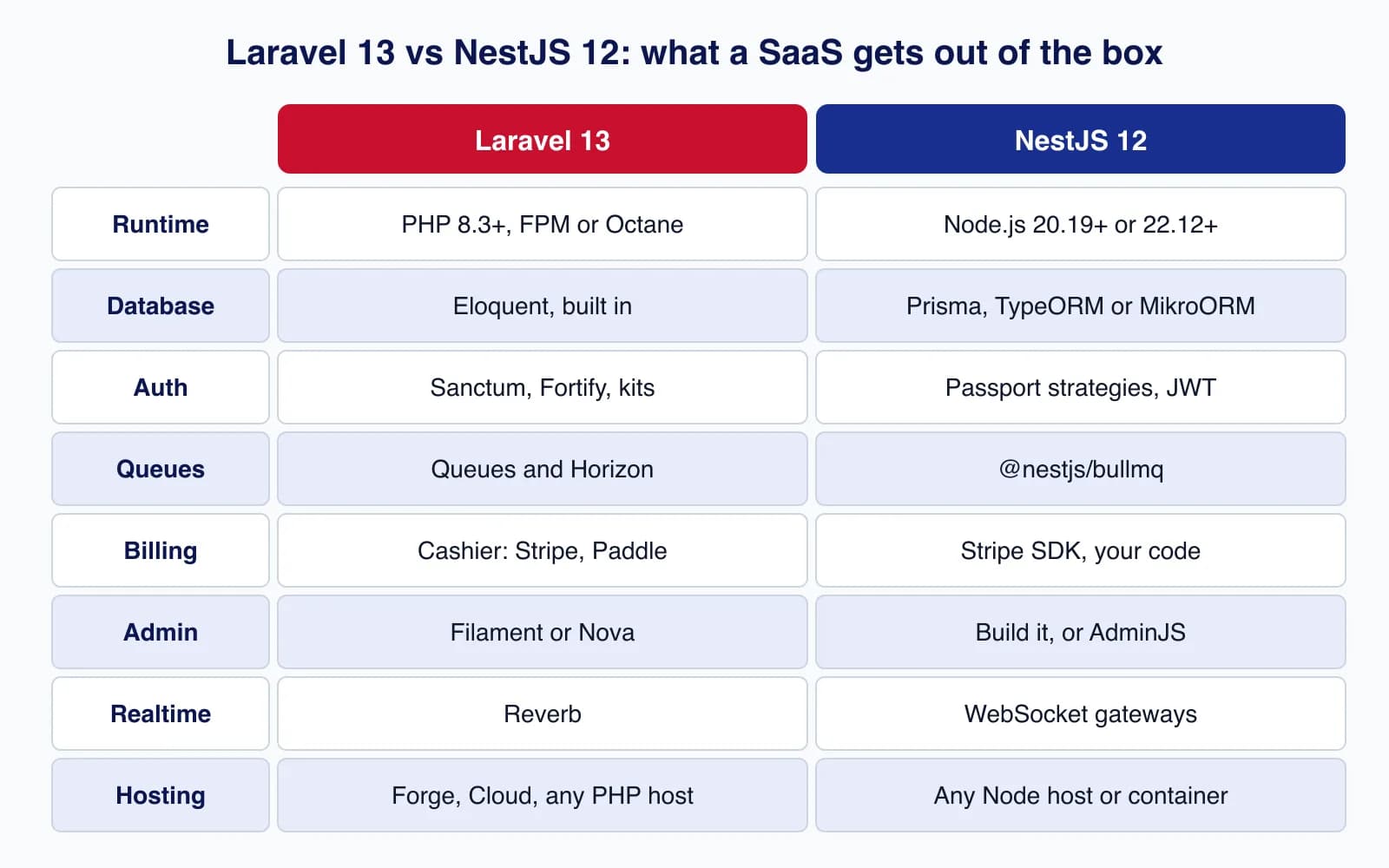
| Need | Laravel 13 | NestJS 12 |
|---|---|---|
| Database access | Eloquent ORM, migrations, factories, all built in | Choose an ORM: Prisma, TypeORM, MikroORM or Drizzle, each with its own migrations |
| Authentication | Starter kits (React, Vue, Svelte, Livewire), Fortify, Sanctum for SPA and API tokens, Socialite for OAuth logins | @nestjs/passport strategies and @nestjs/jwt, or a hosted identity provider; you wire sessions, password reset and email verification |
| Queues and scheduling | Queues with Redis, database or SQS drivers; Horizon dashboard; scheduler in code | @nestjs/bullmq on Redis; @nestjs/schedule for cron-style tasks |
| Subscription billing | Laravel Cashier for Stripe and for Paddle: subscriptions, trials, invoices, webhooks | No first-party package; Stripe's Node SDK plus your own webhook and subscription state code |
| Admin panel | Filament (open source) or Laravel Nova (paid) | No standard choice; AdminJS, or a React admin built with a framework such as Refine |
| Realtime | Reverb, a first-party WebSocket server, plus broadcasting | WebSocket gateways (Socket.IO or ws adapters) built into the framework |
| Validation | Form Requests with rule arrays | Standard Schema (Zod and others) or class-validator DTOs |
| Observability | Pulse, Telescope, logging channels | @nestjs/observe (new, opt-in), OpenTelemetry, structured ConsoleLogger |
| Deployment tooling | Forge, Laravel Cloud, Vapor, or any PHP host; Octane for a long-running server | Any Node.js host, container platform or serverless runtime |
The pattern is consistent: Laravel ships an answer for most SaaS plumbing, maintained by the same organisation and documented in one place. NestJS gives you a strong architectural core (modules, dependency injection, guards, interceptors, pipes) and leaves the surrounding choices to you. That freedom is valuable for a team with opinions and costly for a team that just needs invoices to go out.
The same endpoint in both
To make the difference concrete, here is one endpoint in each framework: an authenticated user creates a project, input is validated, and a provisioning job is queued with retries. Both versions were run and tested.
Laravel 13
<?php

namespace App\Http\Requests;

use Illuminate\Foundation\Http\FormRequest;
use Illuminate\Validation\Rule;

class StoreProjectRequest extends FormRequest
{
    public function rules(): array
    {
        return [
            'name' => ['required', 'string', 'min:3', 'max:120'],
            'plan' => ['required', Rule::in(['starter', 'team'])],
        ];
    }
}<?php
namespace App\Http\Controllers;
use App\Http\Requests\StoreProjectRequest;
use App\Jobs\ProvisionProject;
use Illuminate\Http\JsonResponse;
class ProjectController
{
public function store(StoreProjectRequest $request): JsonResponse
{
$project = $request->user()->projects()->create($request->validated());
ProvisionProject::dispatch($project->id);
return response()->json($project, 201);
}
}<?php
namespace App\Jobs;
use Illuminate\Contracts\Queue\ShouldQueue;
use Illuminate\Foundation\Queue\Queueable;
class ProvisionProject implements ShouldQueue
{
use Queueable;
public int $tries = 5;
public function __construct(public int $projectId) {}
public function backoff(): array
{
return [1, 2, 4, 8];
}
public function handle(): void
{
// create storage, DNS, default records ...
}
}With Route::post('/projects', [ProjectController::class, 'store'])->middleware('auth'), invalid input returns a 422 with field errors, and the feature test uses Queue::fake() to assert the job was pushed once.
NestJS 12
import { Body, Controller, Post, Req, UseGuards } from '@nestjs/common';
import { z } from 'zod';
import { AuthGuard, type AuthedRequest } from './auth.guard.js';
import { ProjectsService } from './projects.service.js';

export const createProjectSchema = z.object({
  name: z.string().trim().min(3).max(120),
  plan: z.enum(['starter', 'team']),
});
export type CreateProjectInput = z.infer<typeof createProjectSchema>;

@Controller('projects')
@UseGuards(AuthGuard)
export class ProjectsController {
  constructor(private readonly projects: ProjectsService) {}

  @Post()
  create(@Body({ schema: createProjectSchema }) body: CreateProjectInput, @Req() req: AuthedRequest) {
    return this.projects.create(req.user.tenantId, body);
  }
}import { InjectQueue } from '@nestjs/bullmq';
import { Injectable } from '@nestjs/common';
import type { Queue } from 'bullmq';
import type { CreateProjectInput } from './projects.controller.js';
@Injectable()
export class ProjectsService {
constructor(@InjectQueue('provisioning') private readonly queue: Queue) {}
async create(tenantId: number, input: CreateProjectInput) {
const project = { id: Date.now(), tenantId, ...input }; // persist with your ORM here
await this.queue.add('provision', { projectId: project.id }, { attempts: 5, backoff: { type: 'exponential', delay: 1000 } });
return project;
}
}Register app.useGlobalPipes(new StandardSchemaValidationPipe()) once in main.ts and BullModule.registerQueue({ name: 'provisioning' }) in the module. In our run, a valid body returned 201, an invalid one returned 400 with Zod's messages ("name: Too small: expected string to have >=3 characters"), and a request without credentials hit the guard's 401. The guard used for the test trusted a header; a real one verifies a session or JWT, which is exactly the part Laravel's starter kits hand you ready-made.
The NestJS version gives you a CreateProjectInput type inferred from the schema, which a React or Next.js frontend in the same repository can import. The Laravel version is shorter and needs no decision about ORM, queue library or validation library, because there is only one obvious choice for each.
Typing and code safety
TypeScript checks types at compile time across the whole stack, and with a monorepo the API contract can be shared with the frontend. PHP has a strong runtime type system (typed properties, enums, readonly classes, property hooks) but checks most types when code runs; PHPStan with Larastan closes much of the gap in CI. In practice, a Laravel team that runs static analysis at a high level gets similar safety for backend code. What it does not get is one type definition shared between the API and a TypeScript frontend without a generation step (OpenAPI or a package such as Laravel Wayfinder for route types).
Performance realities
Benchmarks of "hello world" endpoints tell you little about a SaaS, where most request time is spent in the database, external APIs and serialisation. The architectural differences are what matter:
- Laravel on PHP-FPM boots the framework for every request in a fresh process. It is simple and isolates requests well, but each concurrent request occupies a worker and its memory. Laravel Octane (FrankenPHP, Swoole or RoadRunner) boots once and keeps the app in memory, which removes most of the bootstrap cost but brings the long-running-process rules Node developers already know: no leaking state between requests.
- NestJS on Node.js runs one long-lived process with an event loop, so it holds many concurrent I/O-bound connections cheaply. CPU-heavy work (PDF generation, image processing, large JSON transforms) blocks every request in that process and belongs in a queue worker or worker thread.
- Both scale horizontally behind a load balancer, and both push slow work to Redis-backed queues. Neither will rescue an N+1 query; see fixing N+1 queries in Eloquent for the most common real bottleneck.
If your product is dominated by long-lived connections, such as live collaboration, chat or streaming AI responses to many users at once, Node's model is a natural fit, though Laravel Reverb and Octane cover many of these cases.
Hiring and team fit
The 2025 Stack Overflow Developer Survey gives a rough sense of the pools: 43.6% of respondents used TypeScript and 18.9% used PHP; among web frameworks, 8.9% used Laravel and 6.7% NestJS. TypeScript is the larger language pool, but NestJS-specific experience is not more common than Laravel experience, and many TypeScript developers know Express or Next.js rather than Nest's module and DI patterns.
- A product team with React or Next.js developers who also want to own the backend will usually be productive sooner in NestJS.
- A small team or solo founder who needs billing, admin and auth in weeks rather than months will usually ship sooner in Laravel.
- Agencies and teams maintaining many client apps benefit from Laravel's conventions: every Laravel app looks similar, so people move between projects easily.
- Organisations that already run Node.js services, share libraries across them, or deploy to Node-centric serverless platforms will find NestJS fits their tooling.
Testing and deployment
Laravel's testing layer is one of its strongest features: HTTP tests, database refresh, factories, and fakes for queues, mail, notifications, events and HTTP calls are built in, with PHPUnit or Pest. NestJS provides a TestingModule to build the DI graph with overridden providers, plus Supertest for HTTP; new NestJS 12 projects default to Vitest. Database test setup depends on the ORM you chose.
Deployment is a wash in difficulty but different in shape. Laravel runs on any PHP host with nginx and PHP-FPM, or on managed platforms built for it. NestJS deploys as a Node process or container anywhere Node runs. Both need the same production basics: environment-based configuration, migrations in the release step, health checks, a queue worker process and log shipping.
The choice matters most at the start, when it shapes your data model, auth and billing for years. If you are weighing these options for a new product, SaaS development planning that maps your first year of features to each stack before any code is written is cheaper than switching later.
Decision table
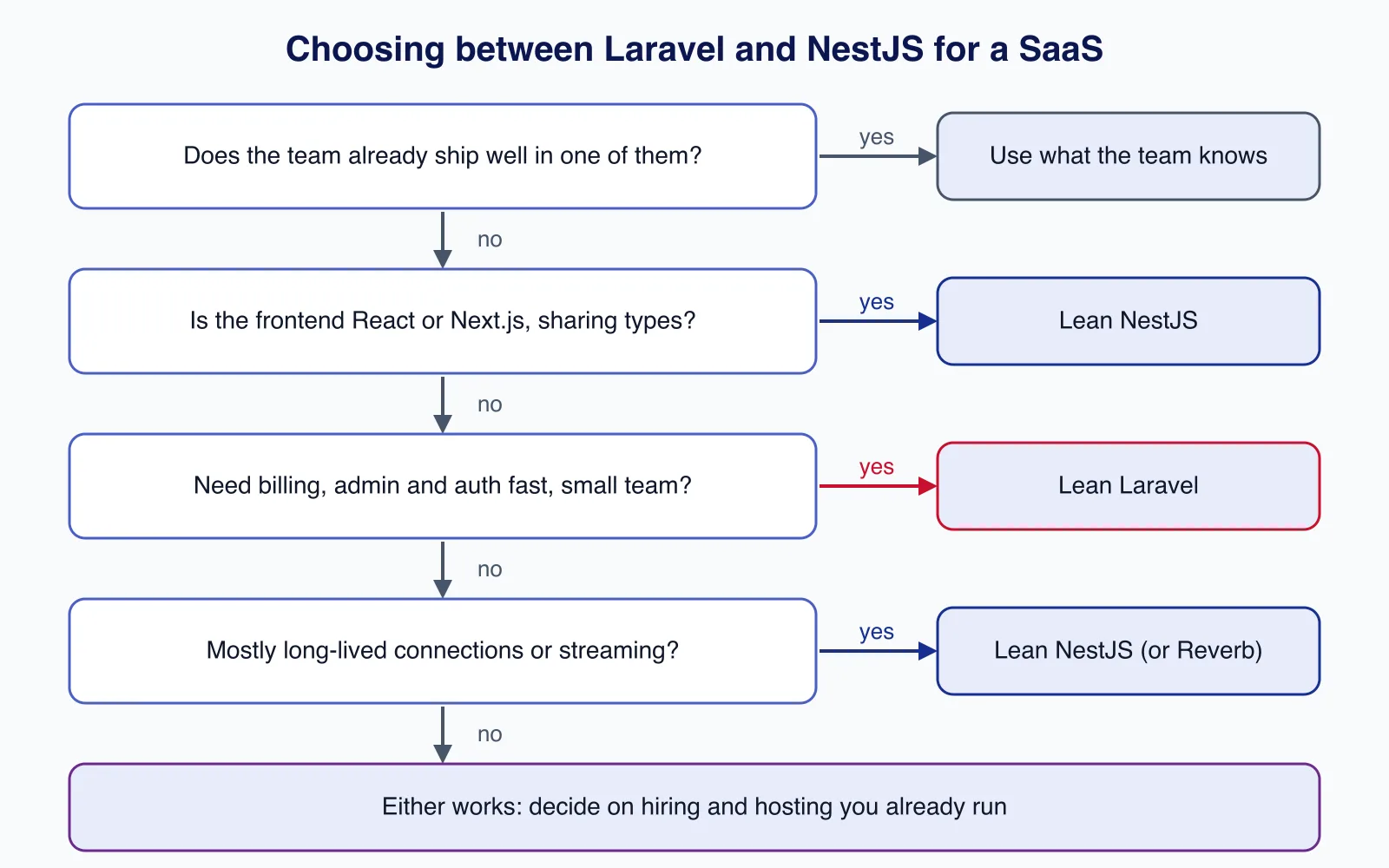
| Your situation | Better fit | Why |
|---|---|---|
| Small team, needs subscriptions, admin and auth quickly | Laravel | Cashier, Filament or Nova, starter kits and Horizon remove months of plumbing |
| React or Next.js frontend, TypeScript team, wants shared types | NestJS | One language, schemas and types shared through a monorepo |
| Realtime-heavy product with many long-lived connections | NestJS (Laravel with Reverb is viable) | Event-loop model suits many idle connections |
| Content-heavy or CRUD-heavy B2B app with complex forms | Laravel | Validation, Eloquent, Blade or Inertia and Filament cover it with less code |
| Several backend services sharing libraries in a Node monorepo | NestJS | Consistent module and DI structure across services |
| Team already strong in one of them | That one | Familiarity outweighs every difference in this article |
| Existing PHP or WordPress estate and PHP hosting | Laravel | Reuses skills, servers and deployment practices |
Common mistakes when choosing
- Choosing on micro-benchmarks instead of on the features you must build in the first six months.
- Picking NestJS and then spending the first month choosing an ORM, auth library, admin tool and billing approach without a decision record.
- Picking Laravel for a TypeScript-only team and then fighting PHP conventions they do not know.
- Planning a split (Laravel API with a Next.js frontend, or NestJS with a separate admin) without budgeting for two deployments and an API contract.
- Assuming the framework handles multi-tenancy; neither does it for you. Our guide to multi-tenant data isolation covers that decision.
When neither is the right answer
If the product is mostly a marketing site with a few forms, a CMS or a hosted platform is cheaper than either framework. If it is a thin layer over a database for internal users, a low-code admin tool may be enough. And if your team is productive in Django, Rails or Spring, the arguments above are rarely strong enough to justify switching.
Cloudsoft Zone builds SaaS products in Laravel and in NestJS, and helps founders choose between them based on the first year of features, team skills and hosting. See SaaS and ERP development.
Frequently asked questions
Is NestJS faster than Laravel?
For typical SaaS requests the database dominates, so the difference is small. Node's event loop handles many concurrent I/O-bound connections in one process; Laravel on PHP-FPM uses a worker per request, and Laravel Octane removes most bootstrap cost by keeping the app in memory.
Which versions should a new project use in 2026?
Laravel 13 on PHP 8.4 or 8.5, or NestJS 12 on the current Node.js LTS. NestJS 12 requires Node.js 20.19+ or 22.12+, and Laravel 13 requires PHP 8.3 or later.
Does NestJS have an equivalent of Laravel Cashier?
No first-party one. You use Stripe's Node SDK and write the subscription state and webhook handling yourself, or use a billing platform that manages it.
Is it easier to hire Laravel or NestJS developers?
The TypeScript pool is larger (43.6% versus 18.9% for PHP in the 2025 Stack Overflow survey), but framework-specific use was similar: 8.9% Laravel and 6.7% NestJS. Hiring ease depends more on your region and salary range than on the framework.
Can I combine Laravel with a Next.js frontend?
Yes, with Sanctum for SPA or token authentication and an API contract between them. Budget for two deployments and keep types in sync through OpenAPI generation.
Your next customer could start right here.
Introduce your tool, product or business to readers exploring technology.
Explore placements and request a private quote
Sources
- Laravel 13 release notes and support policy — Laravel, 2026-03-17
- NestJS v12.0.0 release notes — NestJS on GitHub, 2026-08-27
- NestJS migration guide — NestJS
- NestJS queues (BullMQ) — NestJS
- Laravel Octane — Laravel
- Laravel Cashier (Stripe) — Laravel
- Laravel starter kits — Laravel
- Stack Overflow Developer Survey 2025: Technology — Stack Overflow
- Standard Schema — Standard Schema
Written with substantial AI assistance. Facts checked against cited sources. Editorial policy.
Comments
No comments yet. Be the first to join the conversation.
Leave a comment
Every comment is read by a moderator before it appears. Your email address is never published; it is used only to contact you about this comment.
Related tools
- Directory profile
Cloudflare
Global network service providing DDoS protection, a web application firewall, CDN and DNS, with a free plan for websites.
A tool connected to a service selected for this article. Compare its fit for your project; inclusion is not an endorsement.
- Directory profile
GitHub
Git-based platform for hosting code, reviewing pull requests, tracking issues and running CI/CD workflows, with free and per-user paid plans.
A tool connected to a service selected for this article. Compare its fit for your project; inclusion is not an endorsement.
More from Cloudsoft Zone

ComparisonNode.js
Express 5 vs Fastify 5: which Node.js framework to pick in 2026
Express 5 and Fastify 5 compared on support status, validation, error handling, upgrades and performance, with the same API built and tested in both.
By Cloudsoft Zone

Resource guideResources
Official documentation worth bookmarking for PHP, JavaScript and Node.js developers
A checked list of primary references for web developers: MDN, web.dev, the PHP manual and support schedule, Node.js API docs and releases, TypeScript, Laravel, React and WordPress docs, OWASP Cheat Sheets, DevDocs and endoflife.date.
By Cloudsoft Zone

Industry updateNode.js
Which Node.js version to use in October 2026: LTS lines and the new schedule
Node.js 26 becomes LTS on 28 October 2026, Node.js 24 moves to maintenance and 20.x is already end of life. Here is every supported line, the new yearly release model from Node.js 27, and which version to run.
By Cloudsoft Zone