
Blue-green vs rolling vs recreate deployments: choose a strategy your small team can operate
Compare blue-green vs rolling vs recreate deployments through capacity, mixed-version compatibility, worker behavior and realistic recovery requirements for a small team.
5 min read
In this article
A small SaaS team chooses rolling deployment because it sounds safer. Its one VPS has no spare memory for another runtime, and old workers cannot read the new job payload. The strategy name did not solve either constraint.
Choosing blue-green vs rolling vs recreate depends on capacity and shared state. The guide compares blue green deployment vs rolling mechanics, explains when a recreate deployment strategy is the simplest reliable option, and rehearses failure.
Choosing blue-green vs rolling vs recreate deployments starts with capacity, state compatibility and the interruption your users can tolerate. This comparison gives a practical decision process for Laravel and Node.js applications without assuming every team needs Kubernetes.
Our single-VPS deployment guide covers one implementation boundary. Here the objective is selecting a transition you can operate and verify.
Step 1: Define the service requirement
Write down the affected workflows and acceptable interruption. A public article page, a checkout flow and a long-running export have different operational needs.
Include deployment-time capacity. Building on the production machine or running two versions temporarily may use substantially more memory and disk than steady-state operation. Measure that headroom in rehearsal.
Identify the release owner and recovery procedure. A strategy that nobody can debug during an incident is a poor fit even if its ideal behavior is attractive.
Step 2: Compare the transition mechanics
| Strategy | Transition | Main operating cost | Important failure boundary |
|---|---|---|---|
| Recreate | Stop or remove old runtime, then start new | Explicit service interruption | New runtime may fail after old one is gone |
| Rolling | Replace subsets while others continue | Spare capacity and mixed-version support | A partial release can expose both versions |
| Blue-green | Prepare alternative runtime, then switch | Parallel capacity and routing control | Shared state may already have changed |
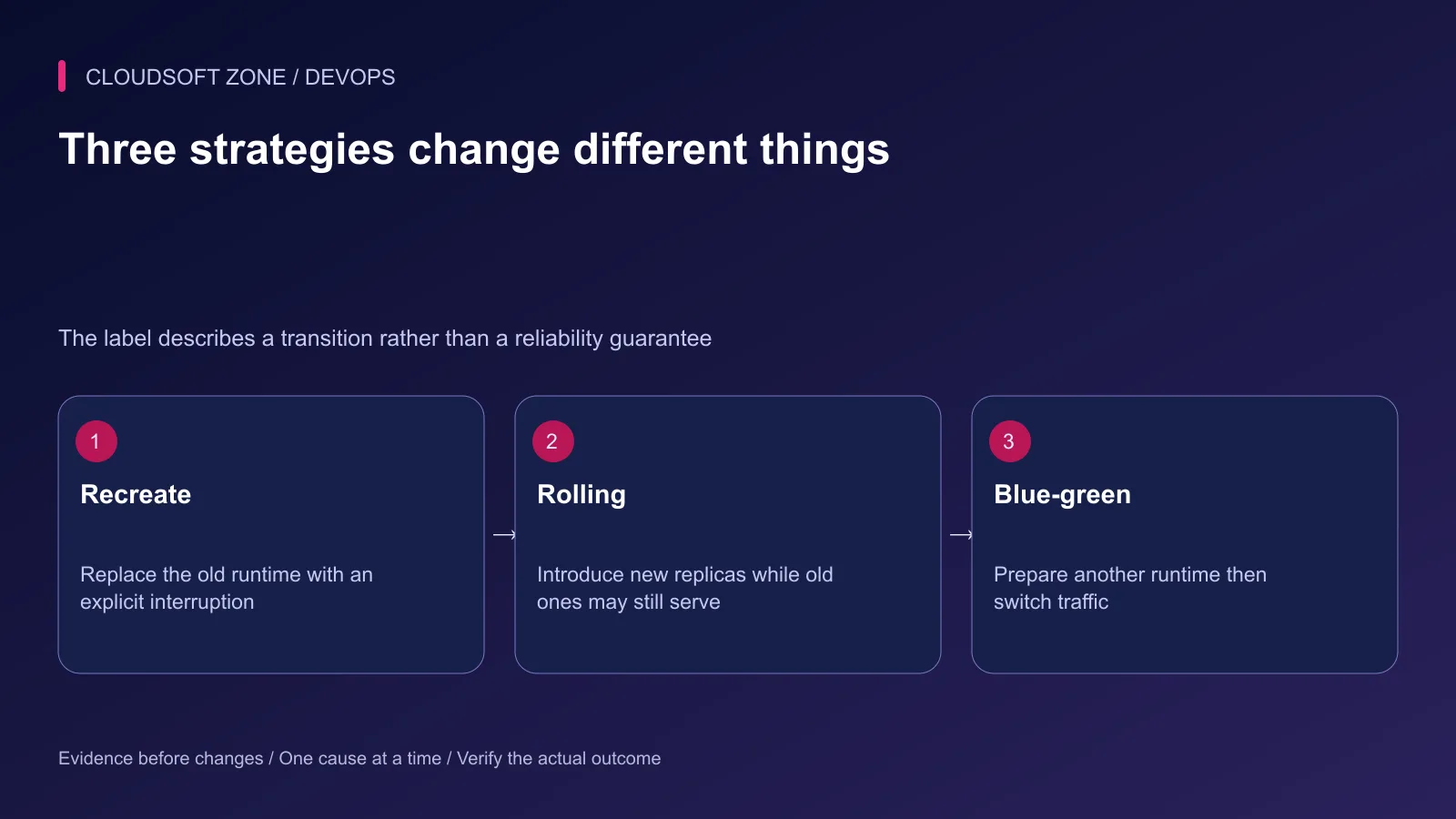
Recreate can be reasonable for a small application with a documented maintenance window. Rolling can reduce broad interruption when enough healthy capacity remains. Blue-green makes a candidate runtime easier to inspect before switching normal traffic.
None of these descriptions establishes high availability against host failure. Two application versions on one VPS still share its power, disk, network and operating system.
Step 3: Review shared state before code switching
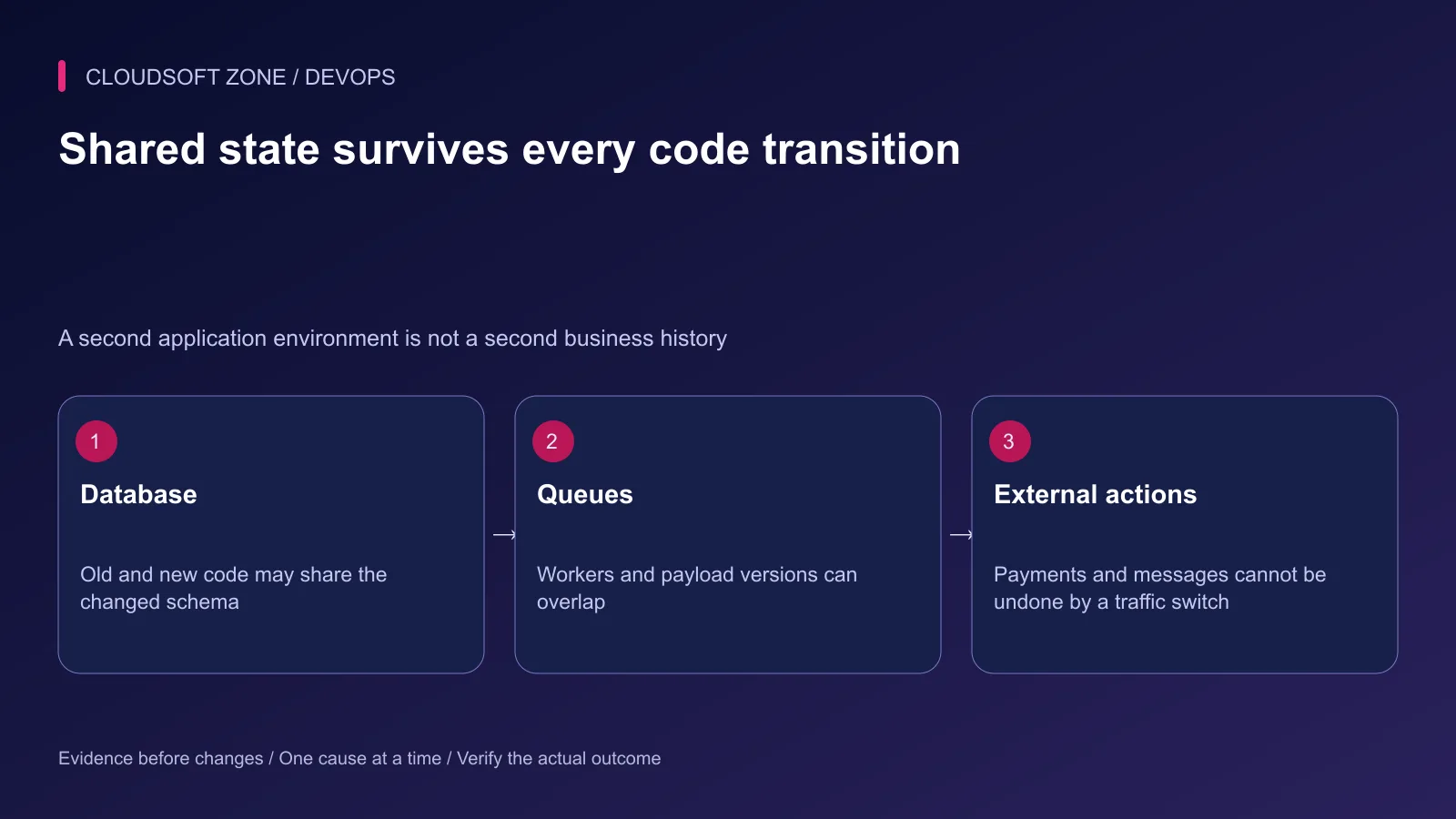
Check database schema, uploaded files, sessions and cache semantics. Determine whether both versions can read and write the state during the transition.
Use additive schema changes where a coexistence window is required. Remove old fields only after old consumers are retired. A traffic switch back to the previous runtime cannot restore a dropped column or reverse a completed payment.
For Laravel and NestJS workers, review job payload versions and retry behavior. An old worker may receive a job created by new code. Draining only HTTP traffic does not retire that worker.
Step 4: Understand rolling capacity controls
Kubernetes provides RollingUpdate and Recreate strategies for Deployments. The fragment below illustrates a rolling capacity budget for three desired replicas; it is not a complete application manifest.
spec:
  replicas: 3
  strategy:
    type: RollingUpdate
    rollingUpdate:
      maxSurge: 1
      maxUnavailable: 0
The surrounding manifest still needs real selectors, containers, readiness, resources and termination behavior. The example requires capacity for an additional replica. A zero unavailable budget is not proof of a zero-error user experience.
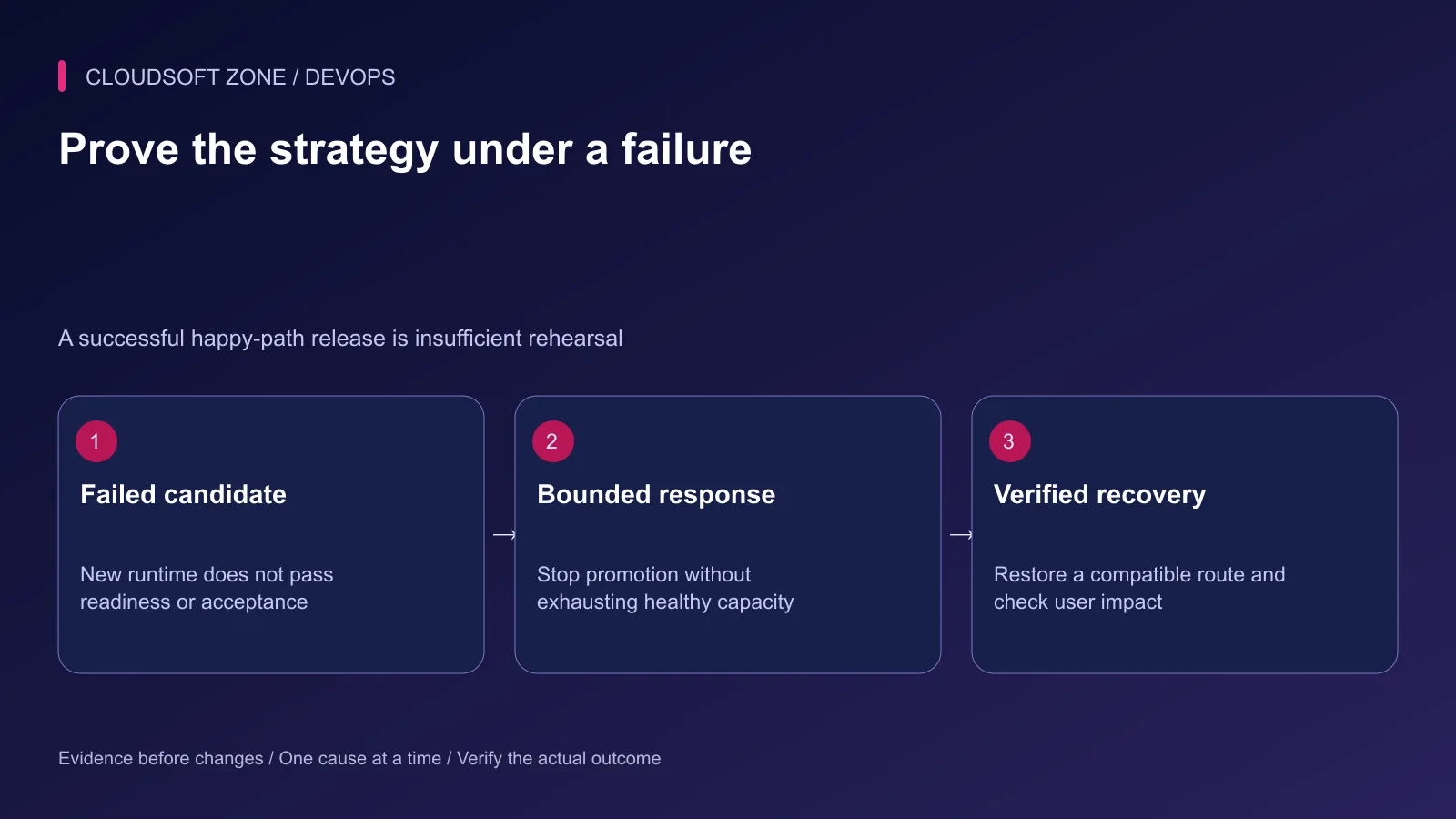
Check what happens when the candidate never becomes ready. The old capacity should remain useful, and the release should reach a bounded unresolved state that an operator can diagnose.
On a VPS without an orchestrator, implement the equivalent transition through the existing process and routing owner. Do not assume Docker Compose's normal replacement behavior supplies a complete rolling-release controller.
Step 5: Make blue-green routing explicit
Prepare the candidate on a separate runtime boundary and verify it with synthetic traffic. Confirm assets, runtime configuration and harmless application behavior before promotion.
Choose the routing mechanism deliberately. A reverse-proxy change, load-balancer update and DNS change have different propagation and connection behavior. Existing long-lived connections can remain attached to an old runtime after new requests switch.
If both environments share a database, call that shared state out in the recovery plan. If they use separate databases, data synchronization and cutover consistency become additional responsibilities, not automatic benefits.
Avoid duplicate scheduled tasks and non-idempotent workers while both environments are available. A candidate environment should not accidentally send live mail or process real payments during inspection.
Step 6: Rehearse failure and recovery
| Rehearsal | Evidence to record |
|---|---|
| New runtime fails readiness | Healthy capacity remains or maintenance is explicit |
| Candidate passes health but fails login | User-flow acceptance stops promotion |
| Worker holds a long job | Drain and timeout behavior preserve its contract |
| Database changes during transition | Both compatible versions remain usable |
| Traffic returns to previous version | Actual public behavior is checked again |
| Spare capacity is exhausted | Release stops rather than overloading the host |
Use a defined observation interval and measure errors, latency and queue progress. Canarying adds a narrower exposure and evaluation pattern, but it still needs enough traffic and meaningful signals to detect a regression.
Step 7: Choose the smallest reliable operating model
Prefer recreate when a short accepted interruption is simpler and safer than unproven coexistence. Prefer rolling when replica capacity, readiness and compatibility are established. Prefer blue-green when candidate inspection and controlled routing justify the parallel environment cost.
Record why the choice fits today's application and what evidence would justify changing it. Growth in traffic alone does not require a particular orchestrator or release strategy.
Our VPS and managed hosting comparison helps evaluate the hosting boundary. For a deployment strategy matched to your application and team, discuss the project with Cloudsoft Zone.
Featured image: Cloudsoft Zone technical layout with docker artwork by dotCloud, Inc. (Apache License 2.0). Product mark resized proportionally for identification; no endorsement implied. Layout: CC BY-SA 4.0.
Frequently asked questions
Is blue-green always zero downtime?
No. Routing, connections, database compatibility and available capacity determine the observed interruption. Verify the actual transition.
Does rolling deployment require old and new code to coexist safely?
Yes. Mixed application versions, worker payloads and older browser clients need a compatible transition.
Is recreate always a bad choice?
No. A short documented maintenance window can be an appropriate tradeoff when the team lacks safe spare capacity or mixed-version compatibility.
Sources
- Kubernetes deployment strategies — Kubernetes
- Pod termination and lifecycle — Kubernetes
- Blue-green deployment framework — AWS
- Canary evaluation and release risk — Google SRE
Read next
TutorialDevOps5 min read
Automated rollback for VPS deployments: release identity, compatibility and recovery gates
Design automated rollback around an exact previous release, schema compatibility and verified user recovery instead of blindly reverting every failed deployment.
Comments
No comments yet. Be the first to join the conversation.
Leave a comment
Every comment is read by a moderator before it appears. Your email address is never published; it is used only to contact you about this comment.
More from Cloudsoft Zone
TutorialDevOps5 min read
Stop a failed database migration from turning into a broken production deployment
Contain a failed database migration with explicit release gates, schema postconditions and reviewed recovery instead of switching code or retrying blindly.
By Nilesh Kushvaha
TutorialDevOps5 min read
GitLab CI/CD for Laravel: test, build and deploy a reviewed release to a VPS
Design GitLab CI/CD for Laravel with a reviewed PHP image, disposable MySQL checks, explicit artifacts, protected credentials and serialized VPS deployments.
By Nilesh Kushvaha
TutorialDevOps5 min read
Laravel CI/CD with GitHub Actions: verification, release artifacts and guarded deployment
Build Laravel CI/CD with GitHub Actions using locked dependencies, isolated verification, immutable release artifacts and a protected deployment job with explicit recovery gates.
By Nilesh Kushvaha