
AI for DevOps: practical log analysis, incident triage and deployment reviews
Use AI for DevOps to summarize sanitized logs, compare incident hypotheses and review deployment plans while preserving evidence, privacy and human control of production actions.
5 min read
In this article
A deployment fails at 14:06, gateway errors increase and the queue begins to age. There are enough records to investigate, but reading every line during an incident consumes the operator's attention. A short summary would help, provided it does not invent a cause or conceal contradictory evidence.
AI for DevOps helps most with tasks that have a reviewable answer. The guide shows AI log analysis on a bounded evidence package with sensitive data removed, and AI incident triage that returns a stable result contract operators can check.
AI for DevOps works best as a bounded analysis layer over trustworthy operational inputs. This guide shows three useful applications: summarizing logs, ranking incident hypotheses and reviewing a proposed deployment. It keeps production decisions with the established release and incident process.
Our AI observability guide covers tracing the analysis itself. Here the focus is how to judge its operational output.
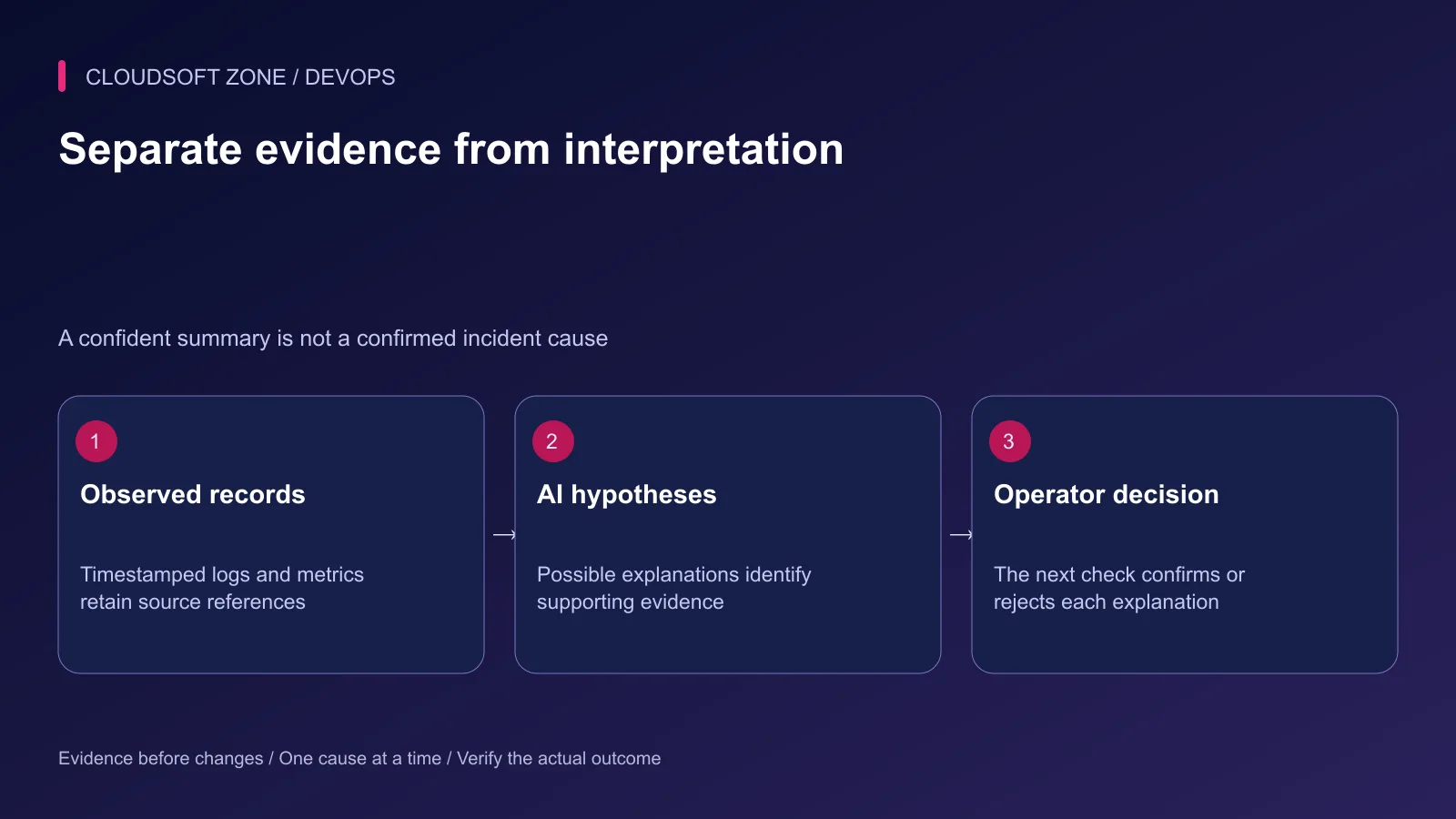
Step 1: Choose a task with a reviewable answer
Ask the model to explain a defined evidence window, not to make the server healthy. The latter instruction combines diagnosis, authority and an unbounded success criterion.
| Task | Useful output | Independent acceptance check |
|---|---|---|
| Log summary | Timeline with record references | Compare to original timestamps |
| Incident triage | Ranked hypotheses and missing evidence | Run a harmless discriminating check |
| Deployment review | Risks tied to concrete plan steps | Inspect artifacts and release gates |
| Communication draft | Plain explanation of verified impact | Incident owner approves facts |
Give the task an explicit time range, service scope and maximum output length. Require the model to say when there is insufficient evidence. A concise unknown is more useful than an invented dependency failure.
Step 2: Collect a bounded evidence package
Start from the existing log and telemetry system. Include release identifiers, stable request or trace references, selected error categories and a small metric window. Avoid exporting complete request bodies just because they are available.
Preserve event timestamps and their timezone. Separate the time an event happened from the time a collector received it. Clock differences and buffering can otherwise create a false sequence.
Assign evidence IDs before submission. For example, E17 may refer to a sanitized application record, and M04 to an error-rate interval. Keep the originals in the authorized system so a reviewer can resolve each reference.
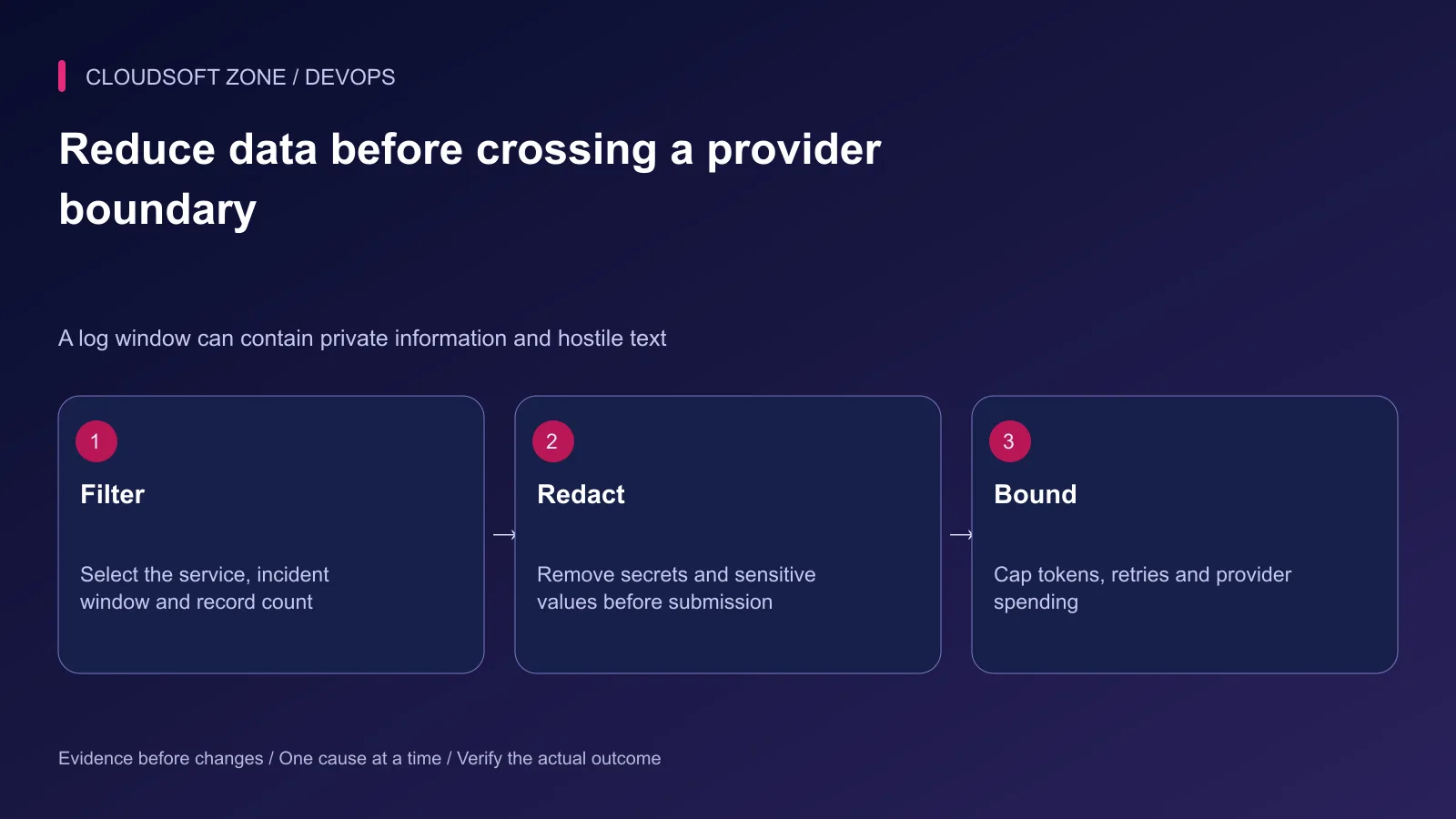
Step 3: Remove data that the analysis does not need
Use server-side allowlists for submitted fields. Redact authorization headers, cookies, passwords, connection strings, personal information and private payloads before they reach a provider adapter.
A regular expression that recognizes one token format is not a complete privacy policy. Combine structured field selection with tested value handling. If an event cannot be made safe, submit an aggregate or exclude it with an explicit missing-data note.
Treat log messages as untrusted input. A request path or user-agent string can contain instructions directed at an AI model. Those strings remain evidence, never permission to call a new tool or reveal another log window.
Step 4: Require a stable result contract
The following JSON is an illustrative output shape, not proof that a provider response is valid. Enforce the actual schema and limits in your application.
{
  "summary": "Errors increased after the release; the cause is unconfirmed.",
  "hypotheses": [
    {
      "claim": "The new runtime may use the wrong database endpoint.",
      "evidenceIds": ["E17", "E19"],
      "contradictions": ["E22"],
      "nextCheck": "Inspect the resolved non-secret endpoint in the release environment."
    }
  ],
  "missingEvidence": ["Authenticated database check from the new runtime"]
}
Reject unknown evidence IDs and oversized output. Do not turn nextCheck into a shell command that runs automatically. Resolve it into an approved diagnostic procedure with its own permissions.
Also distinguish a model's confidence statement from a calibrated measurement. High confidence is not an authentication check, a database query or a verified causal explanation.
Step 5: Review deployments through actual artifacts
Provide a sanitized plan, release identifier, configuration changes and migration outline. Ask for specific hazards: incompatible schema rollback, workers running old code, build-time public variables, missing upload persistence or a failing acceptance check.
Require each finding to cite the corresponding plan step. Do not accept a generic checklist as evidence that the real deployment was inspected.
The Laravel production checklist provides concrete release boundaries. AI can help identify a skipped gate; it should not silently waive one.
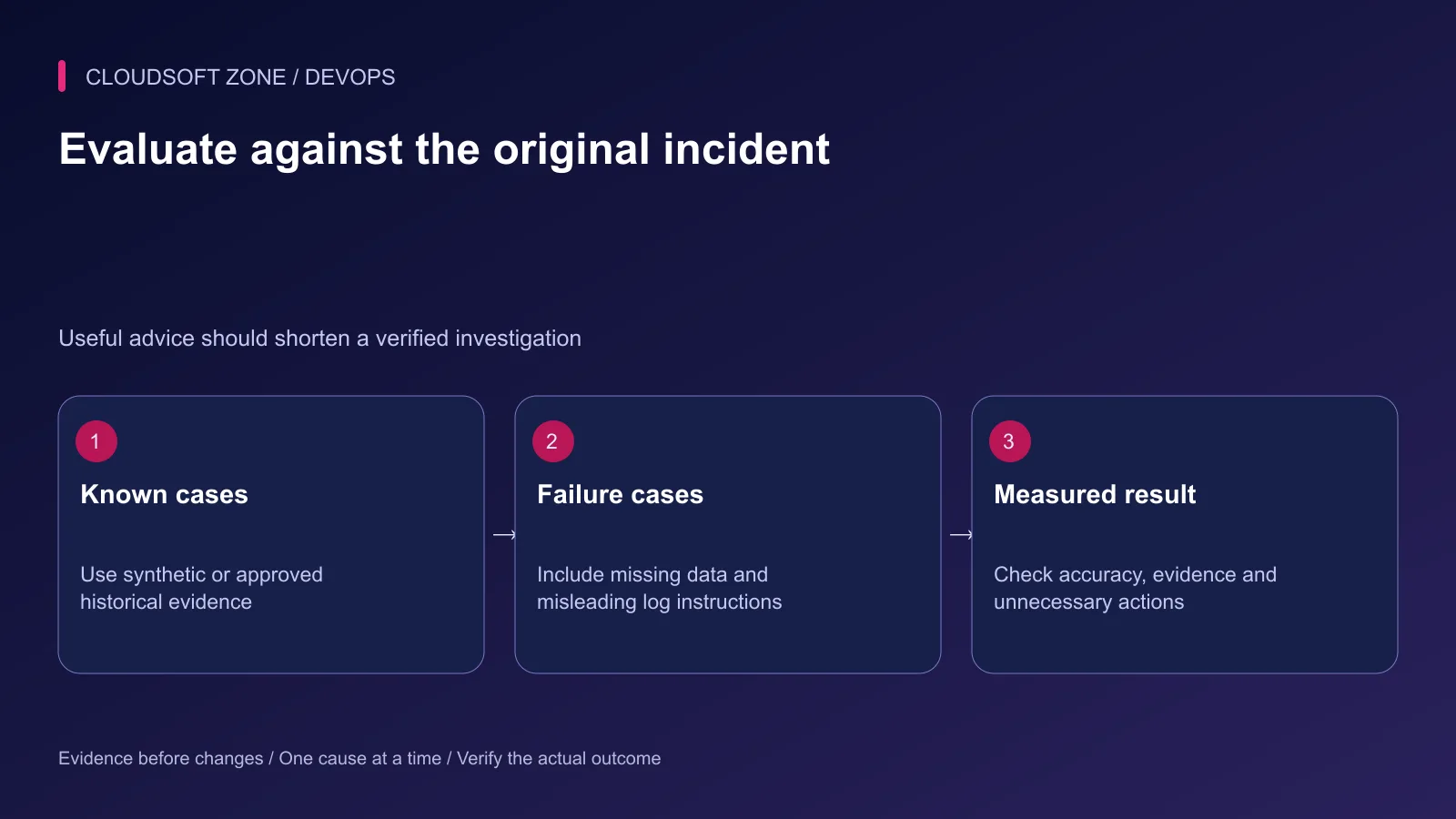
Step 6: Evaluate the advice before operational adoption
Use approved historical incidents or synthetic fixtures with known outcomes. Include a healthy deployment, a wrong-port gateway failure and a database permission problem. Add misleading instructions inside log text and incomplete windows.
| Evaluation | Failure to catch |
|---|---|
| Evidence references | Invented or unrelated record IDs |
| Timeline | Reversed event order or timezone confusion |
| Hypothesis quality | Unsupported certainty or missing alternatives |
| Privacy | Sensitive values appear in submitted inputs or output |
| Action boundary | Suggested text becomes an unapproved mutation |
| Cost budget | Repeated calls continue after the task deadline |
Record the actual evaluation results. Do not publish an improvement percentage without a measured baseline and a defined comparison.
Step 7: Keep the fallback useful
If the provider times out, return the evidence package and normal diagnostic links. The incident process must continue without the model. Bound retries and avoid queuing an unlimited number of summaries during a large outage.
If advice proves wrong, retain the original result with its evidence and review outcome. That record helps improve evaluation cases without rewriting the incident history.
An effective first integration is a read-only panel alongside existing logs, with explicit evidence references and no production execution permissions. For implementation within your Laravel or NestJS stack, discuss the workflow with Cloudsoft Zone.
Featured image: Cloudsoft Zone technical layout with nestjs artwork by NestJS (Public domain). Product mark resized proportionally for identification; no endorsement implied. Layout: CC BY-SA 4.0.
Frequently asked questions
Can an AI summary establish the root cause by itself?
No. Treat it as a set of evidence-backed hypotheses and confirm the relevant system behavior independently.
Should I send all production logs to a model?
No. Use approved data handling, a bounded incident window and server-side redaction before submission.
Which DevOps task is a good first AI experiment?
A read-only review of sanitized logs or an existing deployment plan has a clearer boundary than autonomous production repair.
Sources
- Incident roles and operational coordination — Google SRE
- Incident response practice — Google SRE
- Prompt injection risks — OWASP
- Log records and telemetry correlation — OpenTelemetry
- Define evaluation success criteria — Anthropic
Read next
TutorialDevOps5 min read
AI agents for production servers: permissions, approval boundaries and safe failure
Evaluate AI agents for production servers with bounded diagnostics, backend permissions, resource-specific approvals and failure controls before allowing operational changes.
Comments
No comments yet. Be the first to join the conversation.
Leave a comment
Every comment is read by a moderator before it appears. Your email address is never published; it is used only to contact you about this comment.
More from Cloudsoft Zone
TutorialDevOps5 min read
Docker MCP Toolkit: connect AI agents to development tools through reviewed profiles
Configure Docker MCP Toolkit with a dedicated profile, inspected server permissions, scoped credentials and a harmless connection check before enabling development tools.
By Nilesh Kushvaha
TutorialDevOps5 min read
Run AI coding agents in Docker Sandboxes with controlled workspace and tool access
Run AI coding agents in Docker Sandboxes with an explicit workspace mode, restricted network access, reviewed MCP integrations and a controlled path for accepting changes.
By Nilesh Kushvaha
TutorialDevOps6 min read
Docker health checks: why a running container is not proof that the application is healthy
Design Docker health checks around bounded application readiness, distinguish them from liveness and public-path checks, and connect each failure signal to a deliberate response.
By Nilesh Kushvaha