
OpenAI models on Google Cloud: availability, billing and governance
OpenAI models on Google Cloud: GPT-6 Astra, GPT-6.1 Sol and GPT-6 Luna in private preview in Model Garden. Billing, data boundaries and what is still coming.
Updated 3 min read
In this article
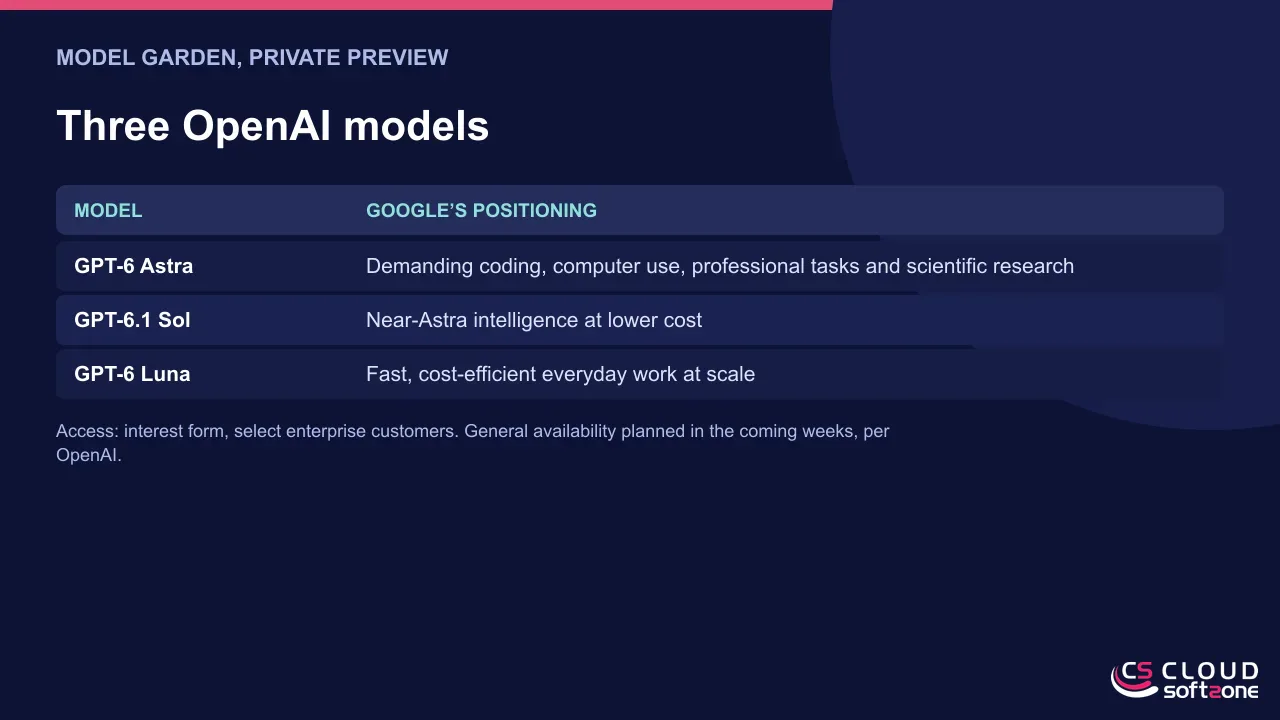
OpenAI models on Google Cloud are rolling out in private preview to select enterprise customers. GPT-6 Astra, GPT-6.1 Sol and GPT-6 Luna are arriving in Model Garden, announced by OpenAI on 21 October and by Google Cloud on 22 October 2026.
OpenAI models on Google Cloud are in private preview, with GPT-6 Astra, GPT-6.1 Sol and GPT-6 Luna arriving in Model Garden. This guide covers OpenAI Model Garden availability, billing through Google Cloud Marketplace, data handling and a governance checklist.
Access starts with an interest form, and OpenAI says general availability is planned in the coming weeks. Zero Data Retention options and Confidential Compute are described as coming soon, not available today.
Sources checked on 26 October 2026. Advisories, prices and availability can change; confirm the linked primary sources before acting.
What is available today
Three models, through Google Cloud APIs, for customers admitted to the preview. Customers can also connect local Codex CLI and Desktop workflows to Google's Gemini platform for inference.
OpenAI models in Gemini for business and Google Antigravity are announced for later. Google also says it is now the only hyperscale cloud offering Gemini, Claude and GPT models together.
Billing through Google Cloud Marketplace
Usage appears on your Google Cloud invoice. Because the models are sold through Google Cloud Marketplace, spend draws down existing cloud commitments and counts toward Flexible Savings Plans.
The announcement did not publish per-token rates. Do not assume they match OpenAI's direct API prices; get a quote before you migrate a budgeted workload.
Direct access vs OpenAI models on Google Cloud
The models are the same family; the operating envelope differs. Compare these points before choosing.
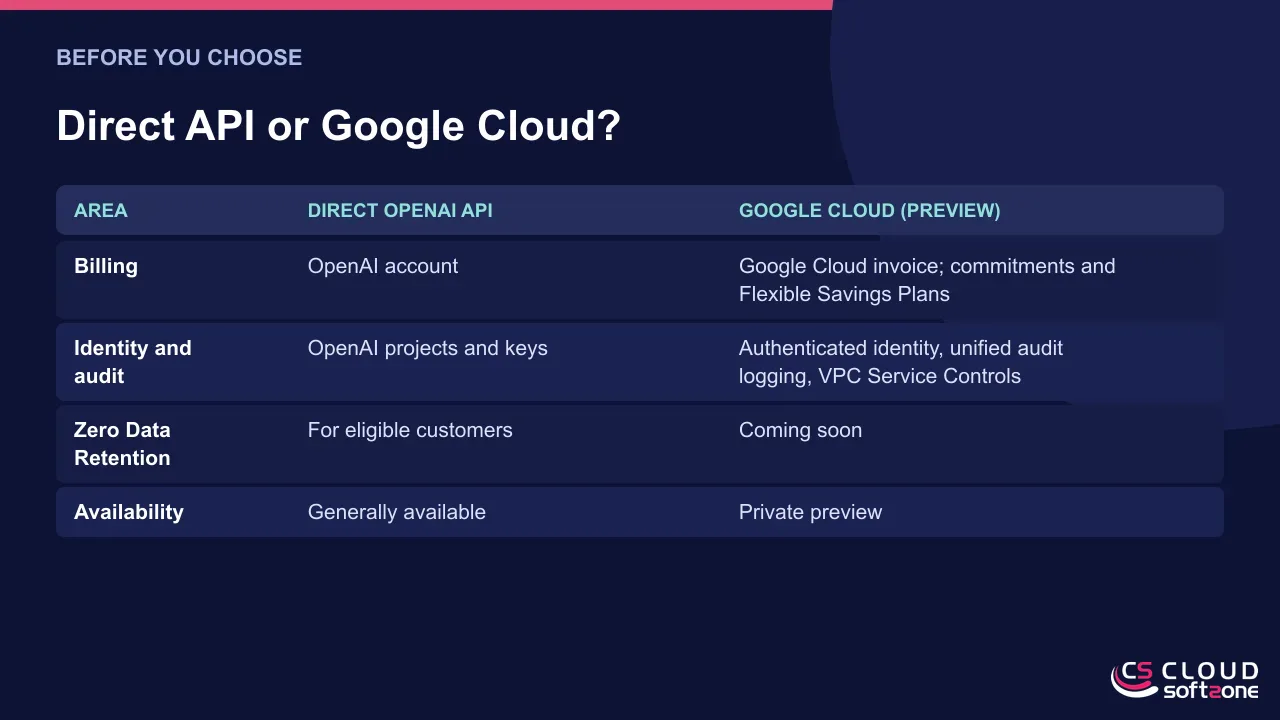
| Area | Direct OpenAI API | Google Cloud preview |
|---|---|---|
| Billing | OpenAI account | Google Cloud invoice, commitments, Flexible Savings Plans |
| Identity | OpenAI projects and API keys | Authenticated identity on every interaction |
| Audit | OpenAI platform logs | Unified Google Cloud audit logging |
| Data boundary | OpenAI data controls | Prompts and outputs stay in your designated perimeter; not used for training |
| Availability | Generally available | Private preview, select customers |
Data handling and what is still coming
Google says prompts, context and outputs stay inside your designated data perimeter and are never used to train foundation models. Queries are routed through isolated gateways inside Google Cloud.
Zero Data Retention options and Confidential Compute are both marked as coming soon. If your data policy depends on either, wait for them to ship before moving regulated workloads.
Governance checklist for enterprise AI
Treat model choice as a routing decision, not a rewrite. These steps keep that option open.
- Send model calls through one internal gateway so a provider switch needs no application change.
- Record which models may process which data classes.
- Apply VPC Service Controls and review the unified audit logs Google describes.
- Keep an evaluation set so a model swap is measured, not assumed.
Our verdict: request preview access if Google Cloud is your main platform and commitments matter, but wait for general availability, ZDR and published pricing before moving regulated workloads. Our provider-neutral AI layer guide shows the routing pattern. For architecture help, see our SaaS development and AI automation services.
Sources and further reading
- Google Cloud brings OpenAI models to customers — Google Cloud
- OpenAI models are coming to Google Cloud — OpenAI
Image credits
Explanatory diagrams: Cloudsoft Zone, CC BY-SA 4.0. Featured photograph: Chad Davis, CC BY 2.0, via Wikimedia Commons. Google Datacenter - The Dalles, Oregon (17832143871): Tony Webster from Minneapolis, Minnesota, United States, CC BY 2.0, via Wikimedia Commons.
Frequently asked questions
Can every Google Cloud customer use OpenAI models now?
No. They are in private preview for select enterprise customers. Google provides an interest form for access requests.
Are prices published?
Not in the announcements. Usage is billed through Google Cloud Marketplace and counts toward commitments; ask Google Cloud for rates.
Is Zero Data Retention available?
Not yet. Google describes Zero Data Retention options and Confidential Compute as coming soon.
Sources
- Google Cloud brings OpenAI models to customers — Google Cloud, 2026-10-22
- OpenAI models are coming to Google Cloud — OpenAI, 2026-10-21
Written with substantial AI assistance. Facts checked against cited sources. Editorial policy.
Read next
TutorialDevOps5 min read
AI-assisted incident response: what to automate and what an operator must decide
Use AI-assisted incident response for evidence summaries and draft updates while keeping impact assessment, production changes and recovery decisions with accountable operators.
Comments
No comments yet. Be the first to join the conversation.
Leave a comment
Every comment is read by a moderator before it appears. Your email address is never published; it is used only to contact you about this comment.
More from Cloudsoft Zone
TutorialDevOps5 min read
Build an AI-powered server log analyser with Laravel or NestJS and bounded jobs
Build an AI-powered server log analyser with authorized evidence snapshots, redacted fields, bounded queue jobs and validated findings that link back to actual records.
By Nilesh Kushvaha
TutorialDevOps5 min read
AI agents for production servers: permissions, approval boundaries and safe failure
Evaluate AI agents for production servers with bounded diagnostics, backend permissions, resource-specific approvals and failure controls before allowing operational changes.
By Nilesh Kushvaha
TutorialDevOps5 min read
AI for DevOps: practical log analysis, incident triage and deployment reviews
Use AI for DevOps to summarize sanitized logs, compare incident hypotheses and review deployment plans while preserving evidence, privacy and human control of production actions.
By Nilesh Kushvaha