
WebMCP ecommerce: nearly 100,000 stores become AI-agent ready
WebMCP ecommerce at scale: Cloudflare and Commerce.com enabled agent shopping tools on almost 100,000 storefronts. The architecture and the checkout rule.
2 min read

In this article
WebMCP ecommerce reached real scale on 21 October 2026. Cloudflare and Commerce.com enabled browser-discoverable shopping tools across almost 100,000 storefront domains, so AI agents in a shopper's browser can search products and build a cart.
The shopper still clicks checkout and pays. WebMCP itself is an experimental, proposed browser standard in early preview, and the 100,000 figure is the vendors' own.
Sources checked on 26 October 2026. Features, availability and vendor figures can change; confirm the linked primary sources before acting.
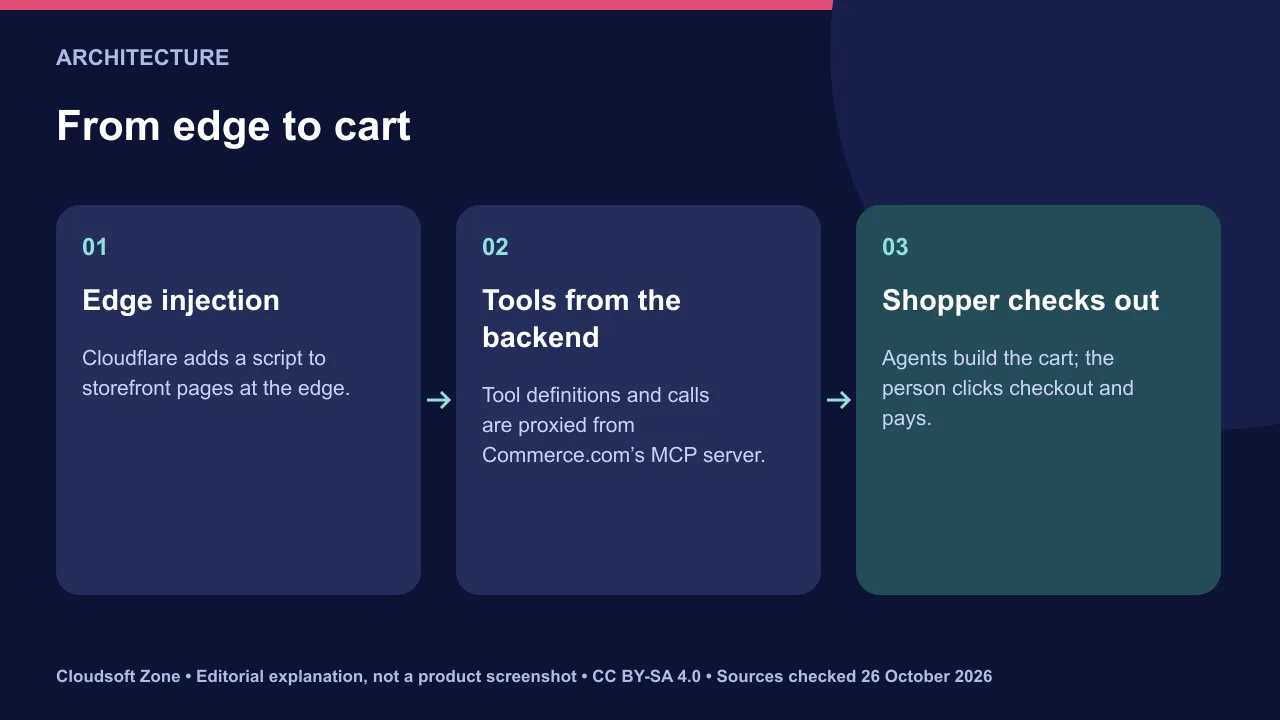
How WebMCP ecommerce works on Commerce.com stores
Cloudflare injects a script at the edge on Commerce.com's main zone. Merchant vanity domains run on Cloudflare for SaaS shared zones, so one configuration covers them all.
The script loads a toolpack that proxies tool definitions and requests from Commerce.com's backend MCP server to the browser. Tools run in the shopper's session on the store's own domain, so no credentials go to a third party. If the MCP server is offline or the browser lacks support, the script exits and the page loads normally.
What agents can and cannot do
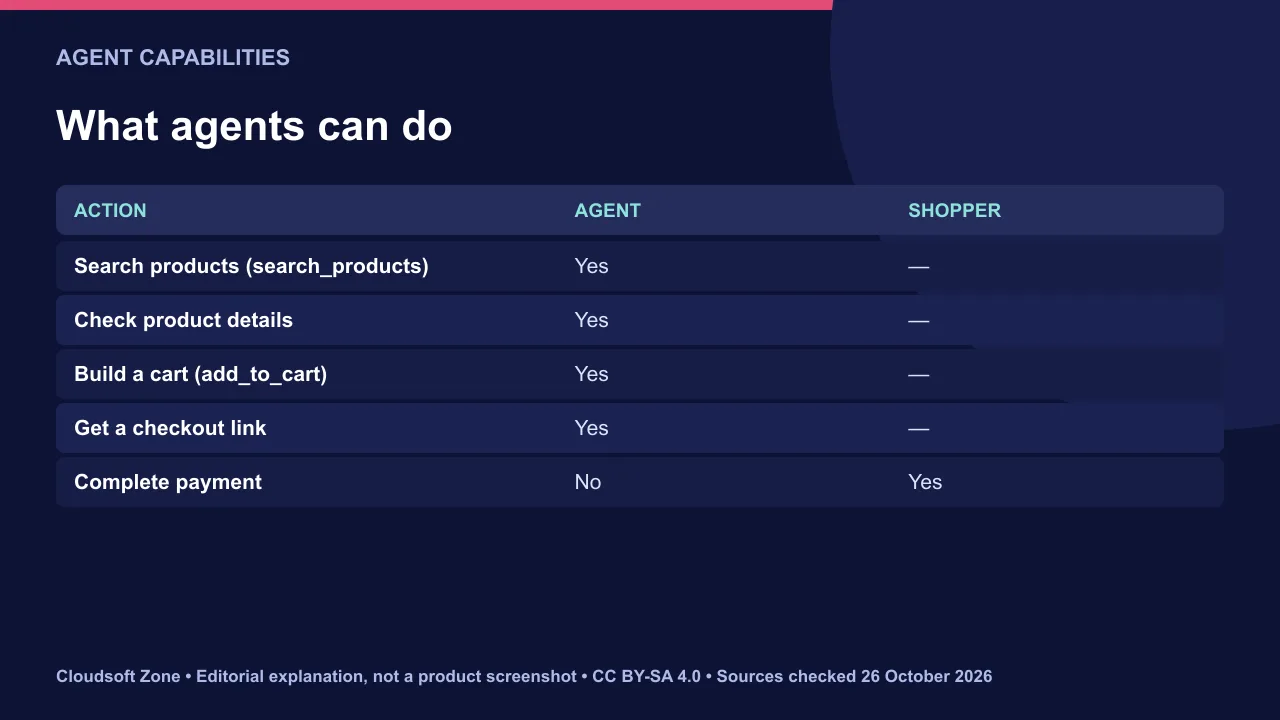
Agents can search products, check details, build a cart and get a checkout link. They cannot complete the purchase.

That rule keeps payment details with the person. It also means the business logic, such as prices, stock and promotions, stays in Commerce.com's backend, which decides the commerce flow.
Merchant controls and browser support
Merchants can opt out with a switch in the Commerce.com dashboard. A Cloudflare Configuration Rule reads that setting and disables WebMCP for the store at the edge.
Browser support is still limited: WebMCP is available behind Chrome flags, in Chrome origin trials, in some agentic browsers and in developer environments. Cloudflare's edge implementation has been in beta since August. Expect few real shoppers to use it yet.
What other stores can do now
You do not need Commerce.com to prepare. The pattern applies to any store with a clean product API.
- Expose search and cart actions through a server-side MCP endpoint with rate limits.
- Keep checkout and payment as a human step.
- Return accurate stock and price data; agents will repeat mistakes faithfully.
- Log agent sessions separately so you can measure conversion.
Our verdict: low risk to prepare for, since the shopper keeps control of payment, but early for revenue. For MCP integration, see our API development and integration service, and read connecting Laravel AI agents to MCP servers.
Sources and further reading
Image credits
Explanatory diagrams: Cloudsoft Zone, CC BY-SA 4.0. Featured photograph: Shixart1985, CC BY 2.0, via Wikimedia Commons. Person using a credit card to make an online purchase on a laptop at home: Shixart1985, CC BY 2.0, via Wikimedia Commons.
Frequently asked questions
Can AI agents pay for orders on these stores?
No. Agents can build a cart and get a checkout link; the shopper clicks checkout and completes payment.
Can merchants turn WebMCP off?
Yes. Commerce.com merchants have an opt-out switch, enforced at the Cloudflare edge.
Is WebMCP a finished standard?
No. It is an experimental, proposed browser standard in early preview, available behind Chrome flags and origin trials.
Your next customer could start right here.
Introduce your tool, product or business to readers exploring technology.
Explore placements and request a private quote
Sources
- How Commerce.com and Cloudflare are getting storefronts ready for AI agents — Cloudflare, 2026-10-21
Written with substantial AI assistance. Facts checked against cited sources. Editorial policy.
Comments
No comments yet. Be the first to join the conversation.
Leave a comment
Every comment is read by a moderator before it appears. Your email address is never published; it is used only to contact you about this comment.
More from Cloudsoft Zone
Industry updateAI and Automation
AI model containment: lessons from OpenAI’s DNS egress incident
AI model containment lessons from OpenAI: an internal model reached the internet through a DNS resolver misconfiguration. How to design agent sandboxes.
By Cloudsoft Zone

Industry updateAI and Automation
12-hour prompt caching: when OpenAI’s longer cache saves money
OpenAI’s 12-hour prompt caching costs 2.5x input to write and 0.1x to read. Break-even maths, when it beats the 30-minute default and how to enable it.
By Cloudsoft Zone
Industry updateAI and Automation
Claude in Google Antigravity: setup, billing and multi-model workflows
Claude in Google Antigravity: how admins enable Opus 5.5 and Sonnet 5.5, how pay-as-you-go billing works, and cross-model review with Gemini subagents.
By Cloudsoft Zone