
OpenAI Decisions API: pricing, use cases and when to use Responses
The OpenAI Decisions API is now GA with gpt-6-luna: predicate, choice and score answers at $0.10 per million input tokens, no output charge. When to use it.
3 min read

In this article
The OpenAI Decisions API became generally available on 22 October 2026. It runs on gpt-6-luna and returns typed answers instead of free text: a probability for a predicate, one option for a choice, or a position on a scale for a score.
Uncached input costs $0.10 per million tokens and output tokens are not charged. OpenAI says it answers about 10× faster than the Responses API; that is a vendor figure, not an independent benchmark.
Sources checked on 26 October 2026. Advisories, prices and availability can change; confirm the linked primary sources before acting.
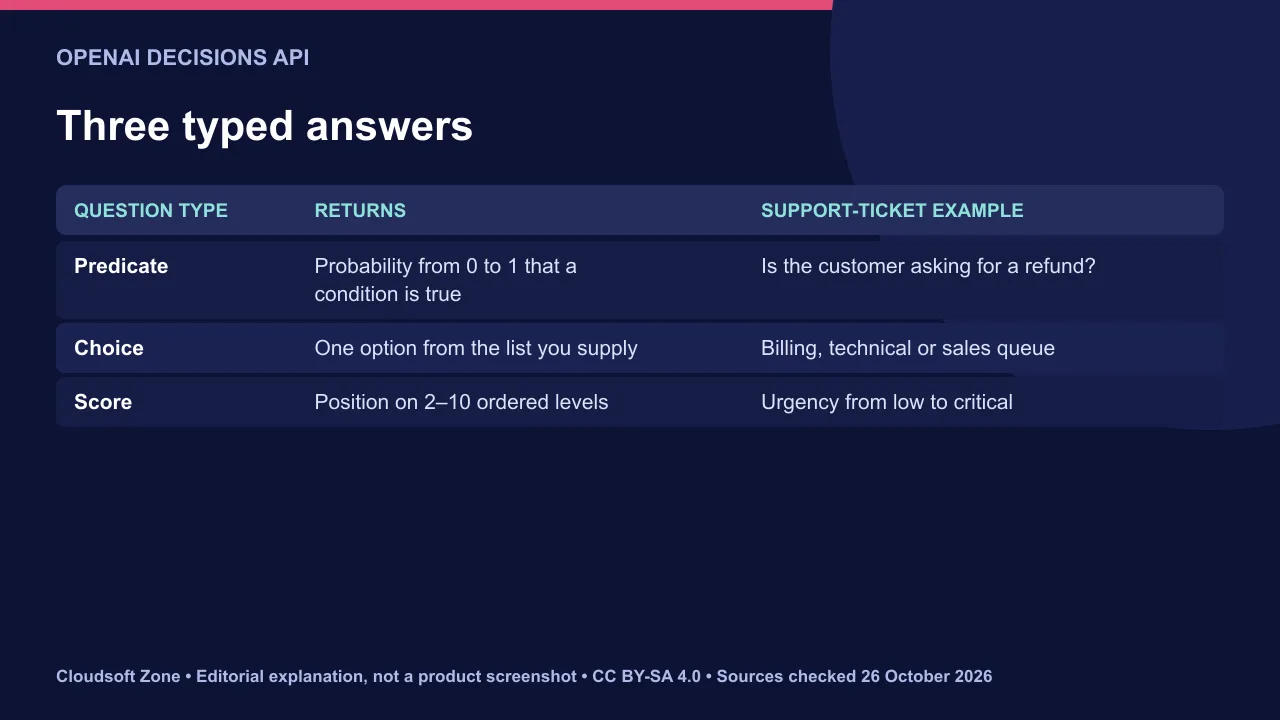
What the OpenAI Decisions API returns
Each request carries input plus a list of named questions. Each question has a type, a unique name and instructions.
| Question type | Answer | Extra fields |
|---|---|---|
| Predicate | Probability from 0 to 1 | None |
| Choice | One option you supply | choices |
| Score | Position on 2–10 ordered levels | levels |
Input can be text, a message array with tool calls and outputs, images as base64 data URLs or HTTPS URLs, and structured data through an input_json content part in user messages. General availability raised the limit to 400 questions per request, up from 200 in the beta that began on 6 October.
Build a support-ticket router
Routing is the clearest fit, because every ticket needs the same small set of answers. Send the ticket once with several questions.
POST /v1/decisions
{
  "model": "gpt-6-luna",
  "input": "Ticket text and customer plan…",
  "questions": [
    { "type": "choice", "name": "queue", "instructions": "Which team should handle this?", "choices": ["billing", "technical", "sales"] },
    { "type": "predicate", "name": "refund", "instructions": "Is the customer asking for a refund?" },
    { "type": "score", "name": "urgency", "instructions": "How urgent is this?", "levels": ["low", "normal", "high", "critical"] }
  ]
}
This request shape is illustrative; confirm exact field formats in the API reference. Set thresholds on the predicate probability, for example tag automatically above 0.9 and send 0.5–0.9 to a person.
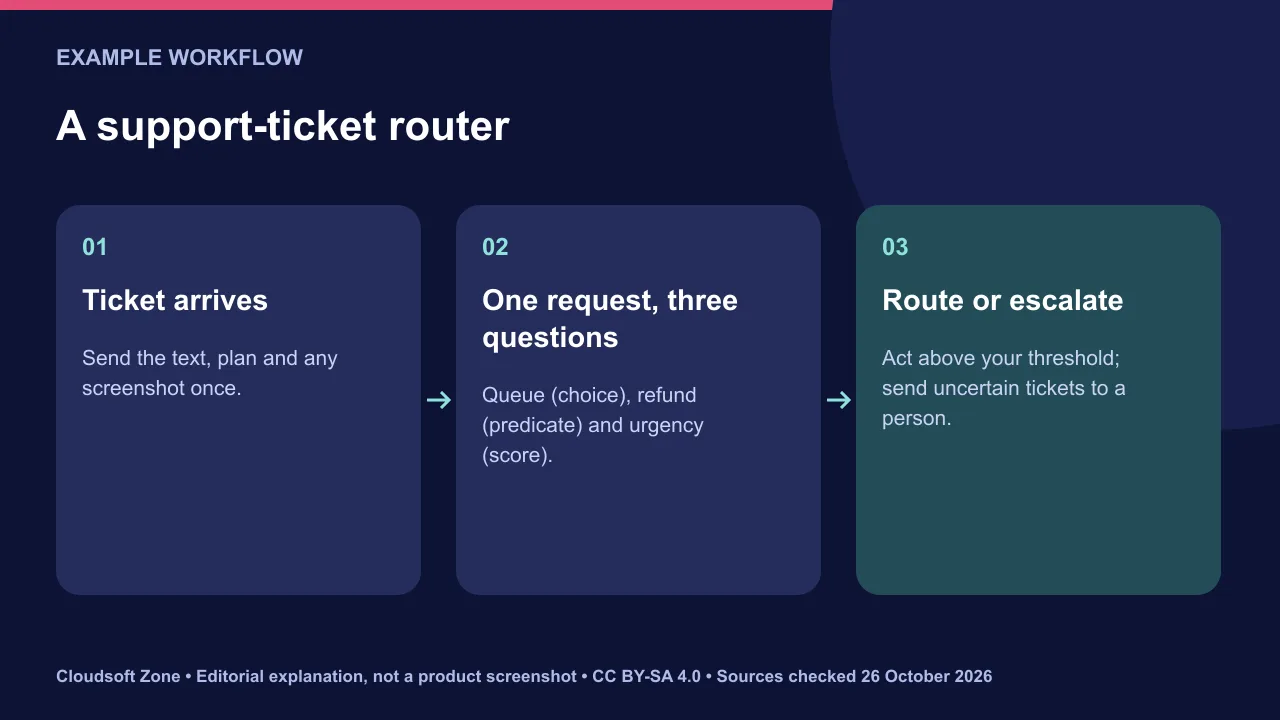
Log every answer with the ticket ID so misroutes can be audited. Re-check thresholds monthly against tickets your team corrected.
Decisions, Structured Outputs or embeddings?
Use Decisions when the answer space is small and fixed. Use other tools when it is not.
- Responses with Structured Outputs: when the model must generate an object that follows your own JSON schema, such as extracted fields or a drafted reply.
- Function calling: when the model should request a tool call with arguments.
- Embeddings: when you need similarity search or clustering rather than a judgement per item.
- Full Responses workflows: when the task needs reasoning, tools and a written answer.
Our guide to structured outputs that return valid JSON covers the generation side.
Cost, caching and regional processing
With no output charge, cost is simply input tokens. Shared instructions repeated across requests benefit from prompt caching: cache hits are discounted and cache writes are charged.
Regional processing is supported in the United States and Europe (EEA and Switzerland), at a premium. OpenAI's pricing page lists a 10% uplift on data-residency endpoints for models released since March 2026. Decisions also integrates with GPT-Live for voice flows.

Our verdict: use the OpenAI Decisions API for high-volume triage, moderation and routing where a person reviews low-confidence cases. Keep generation in Responses. For help designing a router, see our AI business process automation and workflow automation services.
Sources and further reading
- Decisions guide — OpenAI
- API changelog — OpenAI
- API pricing — OpenAI
Image credits
Explanatory diagrams: Cloudsoft Zone, CC BY-SA 4.0. Featured photograph: Fammieomo, CC BY-SA 4.0, via Wikimedia Commons. Aspect Tel-set telephone call centre: Petiatil, CC BY-SA 3.0, via Wikimedia Commons.
Frequently asked questions
Does the Decisions API charge for output tokens?
No. OpenAI’s guide states that output tokens are not charged; you pay for input, with discounted cache hits and charged cache writes.
Is the 10× speed claim independently verified?
No. It is OpenAI’s comparison with the Responses API. Measure latency on your own traffic.
How many questions fit in one request?
Between 1 and 400 since general availability on 22 October 2026, up from 200 during the beta.
Your next customer could start right here.
Introduce your tool, product or business to readers exploring technology.
Explore placements and request a private quote
Sources
- Decisions guide — OpenAI
- API changelog — OpenAI, 2026-10-22
- API pricing — OpenAI
Written with substantial AI assistance. Facts checked against cited sources. Editorial policy.
Comments
No comments yet. Be the first to join the conversation.
Leave a comment
Every comment is read by a moderator before it appears. Your email address is never published; it is used only to contact you about this comment.
More from Cloudsoft Zone
Industry updateAI and Automation
AI model containment: lessons from OpenAI’s DNS egress incident
AI model containment lessons from OpenAI: an internal model reached the internet through a DNS resolver misconfiguration. How to design agent sandboxes.
By Cloudsoft Zone

Industry updateAI and Automation
12-hour prompt caching: when OpenAI’s longer cache saves money
OpenAI’s 12-hour prompt caching costs 2.5x input to write and 0.1x to read. Break-even maths, when it beats the 30-minute default and how to enable it.
By Cloudsoft Zone
Industry updateAI and Automation
Claude in Google Antigravity: setup, billing and multi-model workflows
Claude in Google Antigravity: how admins enable Opus 5.5 and Sonnet 5.5, how pay-as-you-go billing works, and cross-model review with Gemini subagents.
By Cloudsoft Zone