
AI automation for courier and logistics businesses: what works
Address cleaning, ETA messages, exception triage, proof-of-delivery checks and support for couriers: tested code, real API prices and what to keep with people.
Updated 10 min read
In this article
For a courier or last-mile delivery business, the AI automations that pay back fastest are not driverless vans or autonomous planners. They are the unglamorous jobs that cause failed deliveries and support calls: cleaning addresses before a parcel is loaded, telling customers honestly when it will arrive, sorting exceptions so the right person sees them first, checking proof-of-delivery records for the ones that look wrong, and answering "where is my parcel?" without a person reading tracking screens. This guide covers each job, with tested code for address triage and proof-of-delivery checks, published API prices, and a clear list of what you should not hand to AI.
Tested with: PHP 8.5.7 and Laravel 13.21's HTTP client in a scratch app, with Google Address Validation API responses stubbed. Prices are from Google Maps Platform's published price list in US dollars; check current rates before budgeting.
Where AI fits in the delivery flow
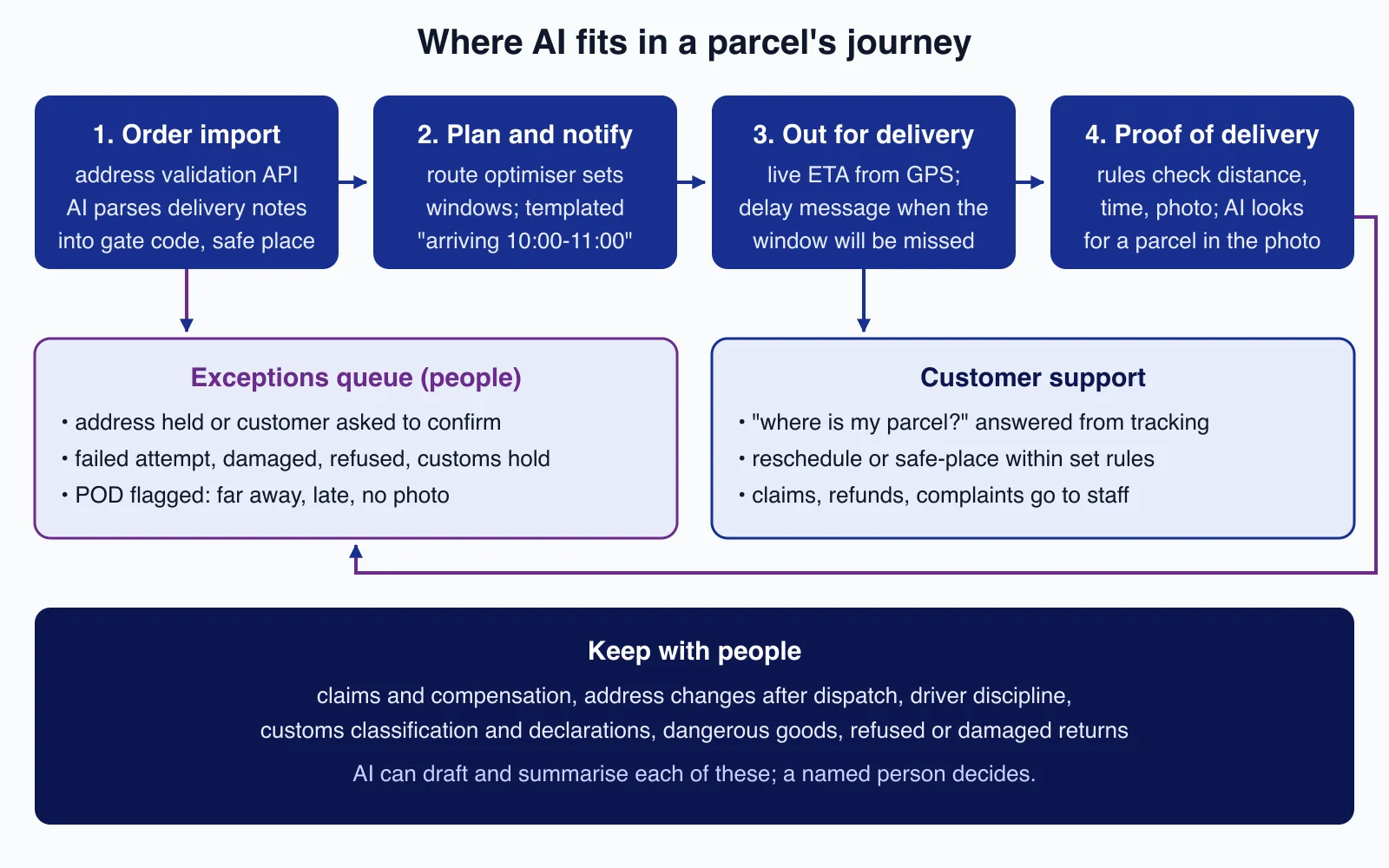
The pattern is the same at every step: rules and well-defined APIs do the deterministic work, AI handles messy text and images, and anything with money, safety or someone's job attached goes to a person with the evidence already gathered.
1. Address cleaning before the van is loaded
A wrong or incomplete address costs a failed attempt, a second run and often a support call. Catch it at order import, when the customer can still fix it.
Validate with an address API, not a language model. Models will happily invent a plausible postcode. Use a validation service with postal reference data: Google's Address Validation API covers many countries; national services such as the USPS APIs (which replaced the retired Web Tools platform in January 2026) cover their own. Google's response includes a verdict with the granularity it could confirm (PREMISE, SUB_PREMISE, ROUTE and so on), flags for replaced or unconfirmed components, and a suggested possibleNextAction such as CONFIRM_ADD_SUBPREMISES when a flat number is missing.
The triage turns that verdict into three outcomes: accept, ask the customer, or hold:
<?php

namespace App\Logistics;

use Illuminate\Support\Facades\Http;

final class AddressTriage
{
    /**
     * @param  list<string>  $lines
     * @return array{decision: string, reason: string, formatted: ?string}
     */
    public function check(string $regionCode, array $lines): array
    {
        $response = Http::timeout(10)
            ->post('https://addressvalidation.googleapis.com/v1:validateAddress?key='.config('services.google.address_key'), [
                'address' => ['regionCode' => $regionCode, 'addressLines' => $lines],
            ])
            ->throw();

        $verdict = $response->json('result.verdict', []);
        $formatted = $response->json('result.address.formattedAddress');
        $granularity = $verdict['validationGranularity'] ?? 'GRANULARITY_UNSPECIFIED';

        // A courier needs a door, not a street.
        if (! in_array($granularity, ['PREMISE', 'SUB_PREMISE'], true)) {
            return ['decision' => 'hold', 'reason' => "Validated only to {$granularity}", 'formatted' => $formatted];
        }
        if (($verdict['possibleNextAction'] ?? null) === 'CONFIRM_ADD_SUBPREMISES') {
            return ['decision' => 'ask_customer', 'reason' => 'Flat or unit number missing', 'formatted' => $formatted];
        }
        if (! empty($verdict['hasReplacedComponents']) || ! empty($verdict['hasUnconfirmedComponents'])) {
            return ['decision' => 'ask_customer', 'reason' => 'Corrected or unconfirmed parts', 'formatted' => $formatted];
        }

        return ['decision' => 'accept', 'reason' => 'Premise-level match', 'formatted' => $formatted];
    }
}
Use AI for the free-text part. Delivery notes such as "gate code 4421, leave with no. 12 if out, dog in garden" are where a language model helps: extract them into structured fields (access code, safe place, neighbour, hazards) so the driver app shows them clearly. Never let the model rewrite the address itself, and keep access codes out of anything that leaves your systems.
What it costs. Google lists Address Validation Pro at $17.00 per 1,000 requests after 5,000 free requests a month. Suppose you import 30,000 parcels a month and 40% go to addresses you have already delivered to successfully, which you skip because your own delivery history confirms them: 30,000 × 60% = 18,000 validations; 18,000 − 5,000 free = 13,000 billable; 13,000 ÷ 1,000 × $17 = $221 a month. Compare that with your cost of one failed delivery and a redelivery. Check the Maps Platform terms on storing results before you cache API responses themselves.
2. ETA communication customers can trust
Customers forgive a late parcel more easily than a wrong promise. The prediction itself comes from your route plan and live GPS, not from a language model:
- Morning window. After route optimisation (your planner, or an API such as Google's Route Optimization, listed at $10.00 per 1,000 single-vehicle requests after 5,000 free), send a window such as "between 10:00 and 11:00" rather than a single minute.
- Proactive delay message. When the live ETA moves outside the promised window, tell the customer before they notice, with a new window and the option to choose a safe place or another day.
- Templates, not free text. Generate messages from approved templates with variables. Use AI to draft and translate the templates once; do not let it compose each customer message.
Follow local consent rules for text messages and keep delivery updates separate from marketing. Rate-limit messages per parcel, so a route that reshuffles ten times does not send ten texts.
3. Exception handling: triage, not decisions
Failed attempts, damaged parcels, refused deliveries, customs holds and "address not found" reports arrive as driver notes, scanner codes, photos and customer emails. AI is useful for turning that mix into a sorted queue: classify the exception, pull the parcel's history, summarise the driver's note, attach the photo and suggest the standard next step from your playbook. A person then picks the action.
Measure the classifier against the people using it. Track how often staff change the suggested category and the suggested next step, per exception type, and only automate a next step (for example, booking a redelivery for "nobody home, first attempt") once the correction rate for it is consistently low.
4. Proof-of-delivery checks
Disputed deliveries are expensive, and most suspicious records can be spotted with simple rules before any AI looks at a photo: where the delivery was recorded, how accurate the GPS fix was, when it happened, and whether the required photo or signature exists.

<?php

namespace App\Logistics;

use DateTimeImmutable;

final class ProofOfDeliveryCheck
{
    public function __construct(
        private int $maxDistanceMetres = 150,
        private int $maxGpsAccuracyMetres = 50,
    ) {}

    /**
     * @param  array{lat: float, lng: float}  $address   geocoded delivery point
     * @param  array{lat: float, lng: float, accuracy: float, at: DateTimeImmutable, photo: bool, signature: bool}  $pod
     * @return list<string>  reasons to send the delivery to a person; empty means it passes
     */
    public function flags(array $address, array $pod, DateTimeImmutable $windowStart, DateTimeImmutable $windowEnd, bool $signatureRequired): array
    {
        $flags = [];
        $distance = $this->metresBetween($address['lat'], $address['lng'], $pod['lat'], $pod['lng']);

        if ($pod['accuracy'] > $this->maxGpsAccuracyMetres) {
            $flags[] = sprintf('GPS accuracy %dm is too coarse to judge location', $pod['accuracy']);
        } elseif ($distance > $this->maxDistanceMetres) {
            $flags[] = sprintf('Captured %dm from the delivery point', $distance);
        }
        if ($pod['at'] < $windowStart || $pod['at'] > $windowEnd) {
            $flags[] = 'Captured outside the route window';
        }
        if (! $pod['photo']) {
            $flags[] = 'No photo';
        }
        if ($signatureRequired && ! $pod['signature']) {
            $flags[] = 'Signature required but missing';
        }

        return $flags;
    }

    private function metresBetween(float $lat1, float $lng1, float $lat2, float $lng2): int
    {
        $r = 6_371_000;
        $dLat = deg2rad($lat2 - $lat1);
        $dLng = deg2rad($lng2 - $lng1);
        $a = sin($dLat / 2) ** 2 + cos(deg2rad($lat1)) * cos(deg2rad($lat2)) * sin($dLng / 2) ** 2;

        return (int) round(2 * $r * asin(sqrt($a)));
    }
}
On top of the rules, an image model can answer narrow questions about the photo: is there a parcel in it, is it a doorway or a locker, is it too dark or blurred to be useful. Treat its answer as one more flag for a person to review, never as proof that a delivery did or did not happen. Delivery photos can show people, house numbers and the inside of homes, so blur faces where you can, restrict who can view them, and delete them on a fixed schedule.
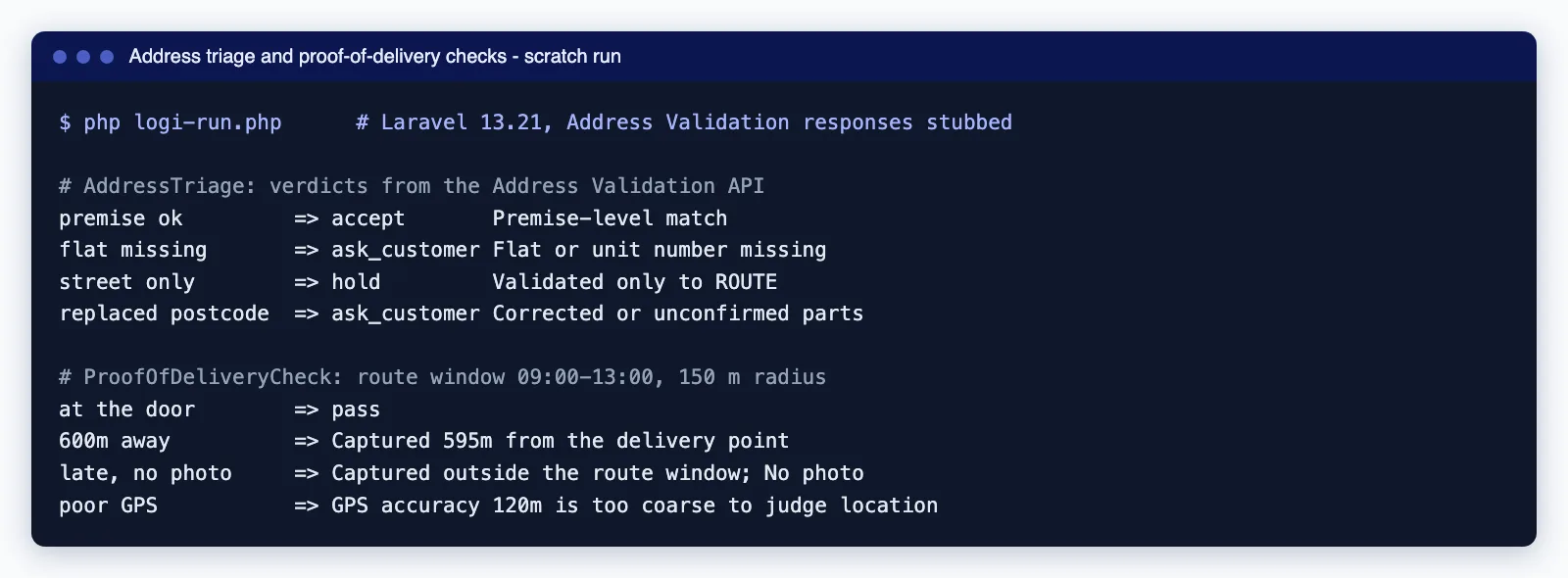
We ran both classes against stubbed API verdicts and four sample deliveries:
5. Customer support
"Where is my parcel?" is the most common question for most couriers, and the answer is already in your tracking data. An assistant that looks up the parcel by tracking number and postcode, explains the latest scan in plain language and offers the self-service options you already allow (reschedule, safe place, collection point) removes a large share of routine contacts. It should hand over to a person, with the conversation attached, for anything involving claims, compensation, damage, missing items or complaints.
Verify identity before revealing anything beyond the public tracking status. A tracking number alone should never reveal the full address, the delivery photo or the ability to redirect a parcel.
What not to automate
- Claims and compensation decisions. AI can assemble the evidence; a person decides and signs off payment.
- Address changes after dispatch. Redirects are a common fraud route. Require verification and, for high-value parcels, a person's approval.
- Driver discipline or deactivation. Do not let scores from proof-of-delivery checks, speed or route adherence trigger sanctions automatically. In the EU, the Platform Work Directive, which member states must transpose by 2 December 2026, requires that decisions to restrict, suspend or terminate a platform worker's account are taken by a human being, with reasons given.
- Customs classification and declarations. AI can suggest a commodity code from a product description, but declarations carry legal liability; a trained person or broker confirms.
- Dangerous goods acceptance. Follow your carrier's and regulators' rules; never let a model decide what is safe to carry.
The integration work (tracking events, driver apps, warehouse systems and carrier APIs) is usually where these projects stall. Cloudsoft Zone's courier and logistics team can connect address checks, ETA messages and exception queues to the systems you already run.
A rollout order that limits risk
- Address triage at import, with "ask the customer" messages. Measure the failed-first-attempt rate for "address problem" before and after.
- Delay messages from live ETAs, using approved templates. Measure "where is my parcel?" contacts per 1,000 parcels.
- Proof-of-delivery rules, sending flagged records to a review queue. Measure disputed deliveries and how many flags staff confirm as real problems; tune the distance and accuracy thresholds by area, because GPS in dense city centres and tower blocks behaves differently from suburbs.
- Exception classification with suggested next steps, recording every override.
- The support assistant, first answering only tracking questions, then adding the self-service actions you already allow on your website.
Each step stands on its own, so you can stop after any of them and still keep the benefit. Keep a manual switch for each automated message type, so operations staff can pause notifications during a depot outage or severe weather without waiting for a developer.
Common mistakes
- Asking a language model to "fix" addresses. It produces confident, invented results. Use validation data and ask the customer.
- Promising exact arrival times. Windows set honest expectations; a missed exact time creates a complaint.
- Sending every flag to the same queue. Sort by cost and urgency: perishable or high-value parcels first.
- Keeping delivery photos forever. Set retention to your claims window plus a margin, and delete.
- No feedback loop. If staff overrides are not recorded, you cannot tell whether the automation helps.
When not to bother
A local courier running two vans with a few dozen drops a day will get more from a good off-the-shelf delivery management app with built-in notifications and photo POD than from custom AI. Custom work pays when you have volume, your own customer-facing tracking, several carriers or depots to join up, or exception handling that already needs a team.
Running a courier, last-mile or logistics operation and want fewer failed deliveries and support calls? Cloudsoft Zone builds courier and logistics software with address validation at import, honest ETA messages, exception queues and proof-of-delivery checks that route the doubtful cases to your team.
Frequently asked questions
Can AI correct customer addresses automatically?
Not reliably on its own. Use an address validation service with postal reference data, accept premise-level matches, and ask the customer to confirm anything corrected, inferred or missing a flat number. Use AI only to structure free-text delivery notes.
How much does address validation cost?
Google Maps Platform lists Address Validation Pro at $17.00 per 1,000 requests after 5,000 free requests a month. Skipping addresses you have already delivered to successfully cuts the bill noticeably; for 30,000 parcels with 40% repeat addresses, it works out at about $221 a month.
Should AI decide disputed deliveries?
No. Use rules to flag records captured far from the address, outside the route window or without a photo, let an image model add observations, and have a person review the evidence and decide.
Can we use AI scores to deactivate drivers?
Not automatically. Scores are noisy and have legal consequences; in the EU, the Platform Work Directive requires that decisions to restrict, suspend or terminate a platform worker's account are taken by a human being. Use scores to prompt a conversation, not a sanction.
Your next customer could start right here.
Introduce your tool, product or business to readers exploring technology.
Explore placements and request a private quote
Sources
- Address Validation API overview — Google
- validateAddress method reference — Google
- Google Maps Platform pricing list — Google
- Web Tools APIs retired January 25, 2026 — USPS, 2026-01-25
- USPS APIs developer portal — USPS
- Directive (EU) 2024/2831 on improving working conditions in platform work — EUR-Lex, 2024-11-11
- Regulation (EU) 2016/679 (GDPR) — EUR-Lex, 2016-04-27
Written with substantial AI assistance. Facts checked against cited sources. Editorial policy.
Comments
No comments yet. Be the first to join the conversation.
Leave a comment
Every comment is read by a moderator before it appears. Your email address is never published; it is used only to contact you about this comment.
Related tools
- Directory profile
Postman
API platform for designing, testing, documenting and monitoring APIs, with desktop and web apps, a CLI and a free plan.
A tool connected to a service selected for this article. Compare its fit for your project; inclusion is not an endorsement.
- Directory profile
Slack
Team messaging platform built around channels and direct messages, with audio and video huddles, canvases, lists and workflow automation.
A tool connected to a service selected for this article. Compare its fit for your project; inclusion is not an endorsement.
More from Cloudsoft Zone

Resource guideBusiness Technology
10 practical AI automation ideas for small businesses in 2026
Ten AI automations that work for small teams in 2026, each with the workflow, real tools and checked prices, rough effort, risks, and the human review step that keeps it safe.
By Cloudsoft Zone

Resource guideResources
Cron syntax cheat sheet: crontab, GitHub Actions, Kubernetes
Cron syntax with tested expressions, the day-of-week trap, and how time zones and limits differ in crontab, GitHub Actions, Kubernetes and Laravel in 2026.
By Cloudsoft Zone

Laravel
Upgrading from Laravel 12 to Laravel 13: a practical guide
Laravel 12 lost bug-fix support in August 2026. This guide covers the PHP 8.3 requirement, Composer changes, the CSRF middleware rename, cache and session hardening, low-impact changes that often bite, and a safe rollout plan.
By Cloudsoft Zone