
tsrs explained: can a Rust port make TypeScript checks 8x faster?
tsrs is an experimental Rust port of the TypeScript compiler from Cloudflare and VoidZero. What the 8x speed and 70% memory claims mean, and how to test it.
3 min read

In this article
tsrs is an experimental Rust port of the TypeScript compiler, announced by Cloudflare on 20 October 2026. Cloudflare and VoidZero are building it with Max Schwenk of Owner.com, in collaboration with the TypeScript team, and it is incubated in the Oxc toolchain.
Early benchmarks show it up to 8× faster, with about 70% less memory, than TypeScript 7.0 using the same number of type-check workers. These are the authors' benchmarks, and the hardware is not listed.
Sources checked on 26 October 2026. Features, prices and availability can change; confirm the linked primary sources before acting.
What tsrs is, and what it is not
It is a faithful port, not a new language or a fork. The authors say the TypeScript team keeps full control of language design.
The goals are shorter waits for type checks and lower memory use, so full development environments can run in more places, including browsers. A WebAssembly package, @tsrs/wasm, is available. The authors argue Rust suits WebAssembly better than Go because Go's Wasm builds must include its garbage collector.
How tsrs compares with TypeScript 7
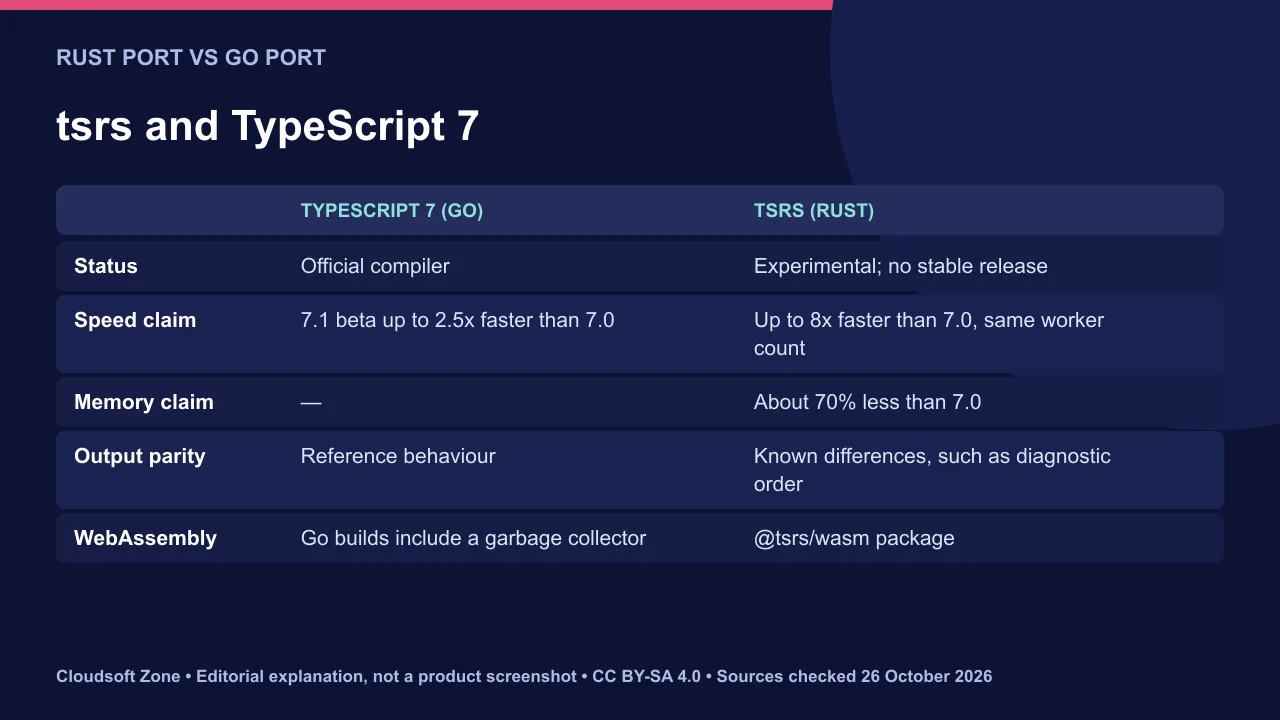
TypeScript 7 is Microsoft's official Go port; tsrs is an independent Rust port. The table compares what each project claims.
| TypeScript 7 (Go) | tsrs (Rust) | |
|---|---|---|
| Status | Official compiler | Experimental, no stable release |
| Speed claim | 7.1 beta up to 2.5× faster than 7.0 | Up to 8× faster than 7.0 at equal workers |
| Memory claim | Not stated | About 70% less than 7.0 |
| Output parity | Reference | Known differences, such as diagnostic order |
Some tsrs optimisations have already been contributed back to TypeScript 7.1, so the gap may narrow. By default tsrs uses an adaptive configuration that uses more memory and runs faster still, so match settings when you compare.
Test tsrs against a real monorepo
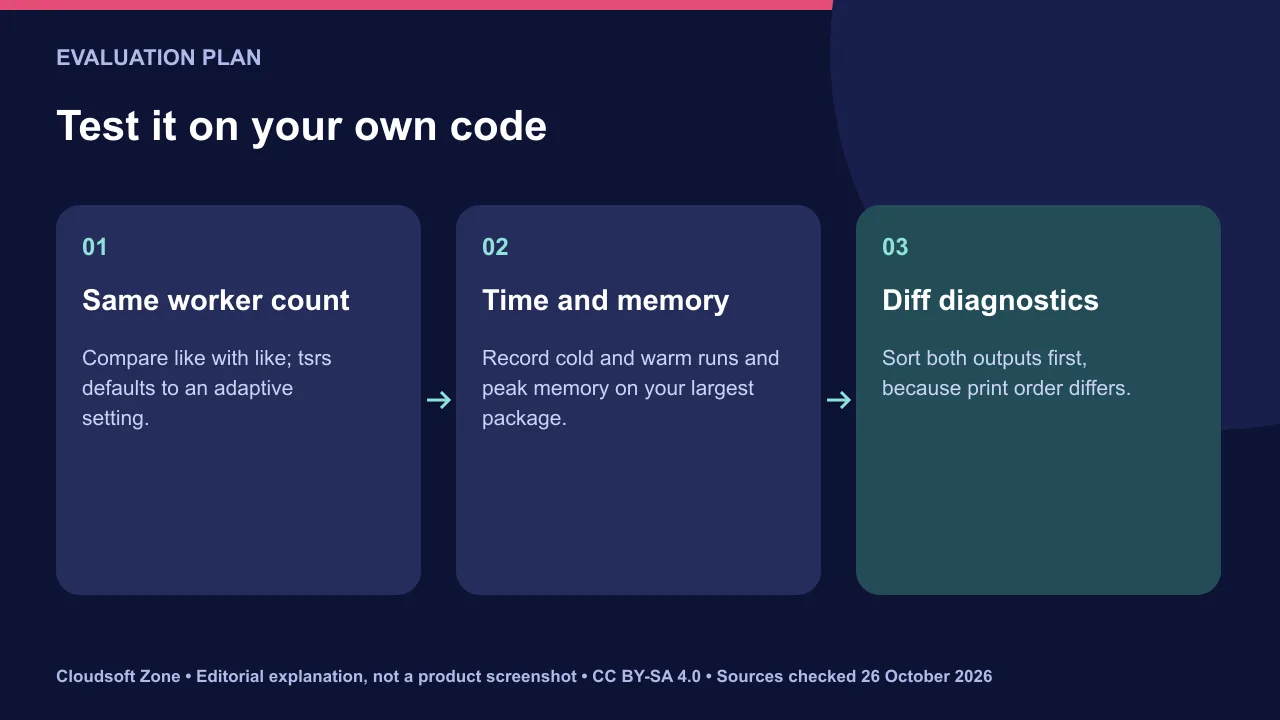
Run it beside your current checker; do not replace it yet. A side-by-side run shows speed and correctness together.
- On a branch, install the
tsrspackage from npm and runnpx tsrsat the project root, following the repository README for options. - Time cold and warm runs of your current check and of tsrs with the same worker count.
- Record peak memory with
/usr/bin/time -von Linux or/usr/bin/time -lon macOS. - Diff the diagnostics after sorting them, because print order differs.
- Repeat on your largest package, not a small example.
Where tsrs could matter: browser and AI coding environments
Memory, not only speed, decides whether a type checker fits in a sandbox. Browser-based and AI coding environments run many isolated workspaces at once.
A smaller footprint could let an agent type-check its own changes inside a sandbox before proposing them. That depends on output parity, though. Until a stable release, keep the official compiler as the gate in CI.
Our verdict: tsrs is worth a benchmark afternoon for large monorepos, not a CI replacement. Related: upgrading to TypeScript 7. If slow builds are hurting your team, our React and Next.js frontend team can audit them.
Sources and further reading
- A Rust port of TypeScript — Cloudflare
- tsrs repository — Oxc on GitHub
Image credits
Explanatory diagrams: Cloudsoft Zone, CC BY-SA 4.0. Featured photograph: HaeB, CC BY-SA 4.0, via Wikimedia Commons. RustCodeOnScreen: Slashme, CC0, via Wikimedia Commons.
Frequently asked questions
Is tsrs ready for production builds?
No. It is an experimental release with known output differences. Keep the official TypeScript compiler as your CI gate.
Is tsrs a fork of TypeScript?
No. It is a port of the compiler; the authors say the TypeScript team keeps full control of language design.
Can tsrs run in a browser?
A WebAssembly package, @tsrs/wasm, is available, and running toolchains in browsers is one of the project’s goals.
Your next customer could start right here.
Introduce your tool, product or business to readers exploring technology.
Explore placements and request a private quote
Sources
- A Rust port of TypeScript — Cloudflare, 2026-10-20
- tsrs repository — Oxc on GitHub
Written with substantial AI assistance. Facts checked against cited sources. Editorial policy.
Comments
No comments yet. Be the first to join the conversation.
Leave a comment
Every comment is read by a moderator before it appears. Your email address is never published; it is used only to contact you about this comment.
More from Cloudsoft Zone
Industry updateJavaScript
React 19.3 explained: ViewTransition, Fragment refs and browser()
React 19.3, released on 9 September 2026, makes ViewTransition and Fragment refs stable, adds browser() to React DOM, supports Trusted Types and lets Server Components render Context directly. Here is what each change replaces and how to upgrade.
By Cloudsoft Zone
TutorialJavaScript
DisposableStack is not defined: fix it and use JavaScript using
Learn JavaScript's using and await using declarations, Symbol.dispose and DisposableStack, with tested browser recipes and October 2026 support data.
By Cloudsoft Zone
Industry updateJavaScript
ECMAScript 2026 is final: 7 new JavaScript features explained
ES2026 adds Map upserts, Iterator.concat, Base64 on Uint8Array, JSON source text, Math.sumPrecise, Error.isError and Array.fromAsync. Examples and support.
By Cloudsoft Zone